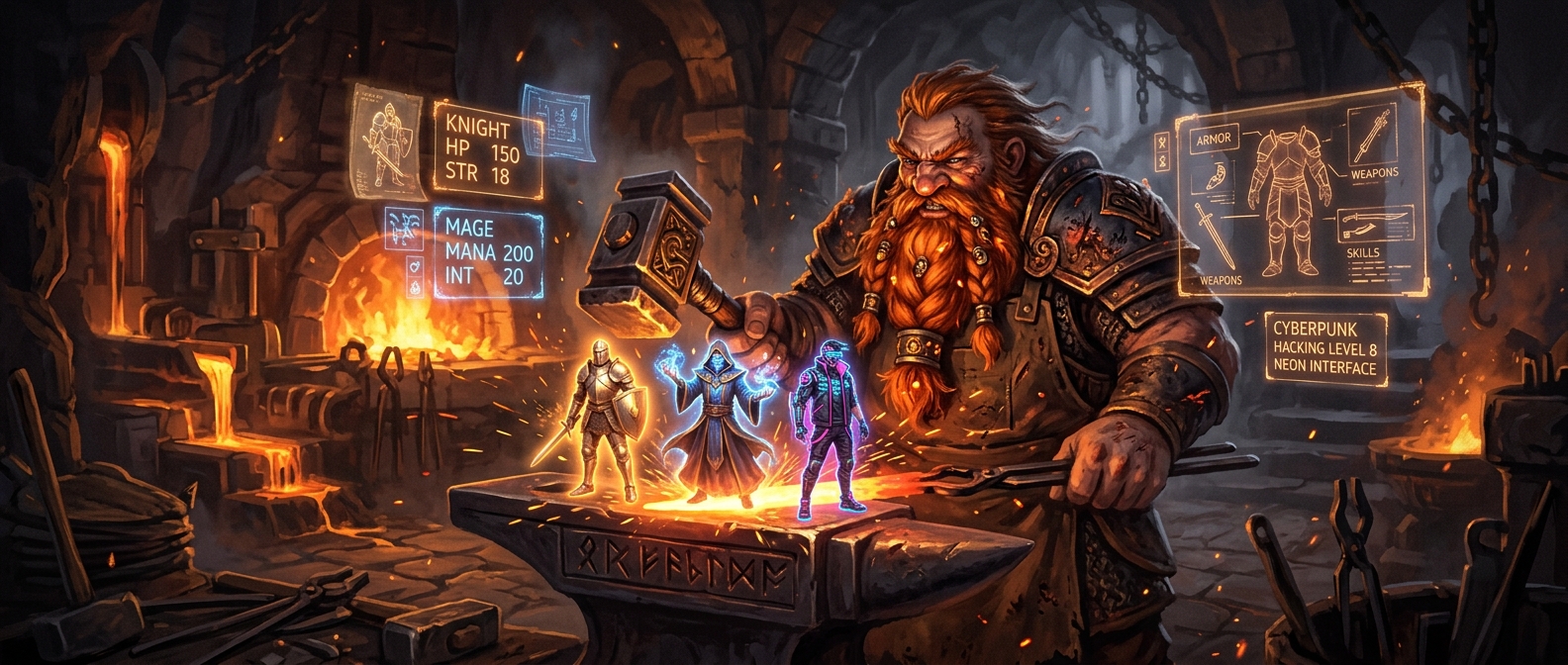
Follow along as we build FableForge. Here you'll find feature announcements, development updates, and behind-the-scenes looks at what we're creating.
Chapter 1.5: Readying for Battle
September 28, 2026
Last week we told you combat was in its final stages. This week we can tell you it is built.
What we cannot tell you is that it has shipped.
The Short Version
No platform update again this week - the second in a row. Next week that changes.
The combat foundation is in and working - the whole engine, end to end: how a fight starts, how a turn resolves, what a beating leaves behind, and what the world remembers afterwards.
The fight runs in Immersive Mode too - the combat screen and its windows have been rebuilt for the full-screen mode, so a fight looks and moves like the rest of the game rather than a system bolted to the side of it. Novel Mode's fight is untouched for anyone who prefers it.
Now we weave it into something to play - what is left is the world the fighting happens in, and the balancing that only ever comes from playing it over and over.
So instead of an update, here is the system - the whole of it, below. Brawls that end with someone on the floor and fights that do not. Initiative. Called shots. Mercy. Looting. A world that remembers who swung first.
Next week's update is already built and waiting - your sessions said to be private in plain words, the interface's speed back, three fixes you may have noticed, and a systems page that keeps itself honest. None of it is combat, and all of it goes out together.
Two Quiet Weeks
We shipped something every week for well over a month. Then we stopped twice in a row, and that deserves plainer speaking than "combat is coming".
So, plainly: every stage of the combat engine is built. It was built in stages, and each stage was played properly - one case at a time, with everything the play turned up fixed before the next stage began. The automated suite that guards the platform crossed eleven thousand checks along the way. Fights start. Turns resolve. The dice behave. People fall over and stay fallen. The world afterwards is not the world before.
That is the foundation, and in an AI RPG the foundation is the hard part: a fight has to be a set of rules the dice can settle and a story the narration can tell, at the same time, every single turn.
It is also not the part you touch. Next week the platform moves again - not with combat, but with everything else that piled up behind it while combat was being built.
What "Readying for Battle" Means
We built combat on Fable Forge's classic screens on purpose.
Novel Mode - the original page-of-prose reading mode - has panels and modals we already trust, and a fight is the worst possible place to be debugging a new interface at the same time as new rules. So the rules got the old furniture, deliberately, and every argument about how a fight should work was settled without an argument about how it should look.
Then we went back and did the looking properly. Immersive Mode, the full-screen mode that became the default two weeks ago, covered every surface in the game except one, and combat was the one. That gap is now closed. The fight has been rebuilt as a proper Immersive stage: the room you are fighting in, the people in it, the turn order, your dice and your damage, all in one place that holds still while you read, with the same transitions in and out as everything else you do. And as with every other screen, Novel Mode's version is untouched for anyone who prefers it.
So the engine is in, and it now looks like the rest of the game. What is left is the part with a story in it - the world the fighting happens in, the encounters worth walking into, and the balancing that only ever comes from playing the thing over and over until the numbers stop being interesting and the fight starts being interesting.
Last week we said very soon, and we meant it. We are still not putting a date on it, because what is left is the part you actually play.
In the meantime, here is what you will be able to do with it.
How a Fight Starts
In more ways than you would expect, and hardly any of them is a button marked Fight.
You can start one from a character's card - attack, or start a brawl instead, or bring your party in with you. You can start one from inside a conversation, where choosing to attack throws a two-dice contest first: whoever wins it moves first, and that is the whole difference between a fight you chose and a fight you merely began.
You can also start one without meaning to. Describe what your character does, and if what you wrote reads as an attack, the game asks whether you meant it before it commits you. Threaten someone and you may get your answer back and then a question: this is turning into a fight, is that where you are going? The other side has the same freedom. Someone who has heard enough can swing first, and a hostile who knew you were coming can ambush you on arrival, with the dice thrown after you have read where you are.
And when a fight cannot happen, you get a sentence instead of an error. They are not here. You can't fight them. There's no one to fight here. That sounds like a small thing. It is the difference between a world with rules and a piece of software with a problem.
Not Every Fight Is To the Death
A brawl and a fight are different things.
A brawl ends with someone on the floor, not in the ground. Reach for a killing weapon in the middle of one and what happens depends on the world you are in: the blow lands as a knockout anyway, or the move is refused outright, or the brawl stops being a brawl - which is its own kind of story. A fight that started deadly never softens back into a brawl.
And you cannot accidentally murder your own story. Anyone a quest you have open still needs will be knocked out rather than killed, however the dice fall. Finish that quest or walk away from it, and the protection lifts with it.
The Turn, and the Roll
In the fullest worlds, everyone shares one queue, shown as a turn order you can read, and anyone who beat you to it acts before your first turn - so a fight can be half lost before you move. Simpler worlds keep it to a trade: you act, one of them answers.
Every attack is a Forge Roll, the same hundred-sided die you have been throwing at locks and lies all along, with your move's attack set against your target's defence, their guard and their gear. How well you rolled is how much it hurts: a forge critical, a clean success, a partial, a failure, or a catastrophe, scaling the damage from devastating down to nothing at all. Armour and a good guard make a blow harder to land. They never soften one that does.
Your options are not a fixed list of three. They come from you, from what you are carrying, and from the room you are standing in. Change your gear and you can do different things, because the moves and the numbers ride the equipment - which is why disarming someone takes their options away along with their weapon. The room lends moves to everybody, and your opponents will reach for them too, though the table only gets thrown once.
Alongside your move sit two boxes: what your character does, and what they say while doing it. Both are narrated as your own, in your own voice, with the move. Or skip, and say nothing at all - a skipped turn stays silent whatever you typed, and what you typed waits for the next one.
Aim Somewhere Specific
Some moves let you choose where to hit.
A called shot is harder to land, and the penalty comes off the roll and nothing else - but a blow that does land leaves a mark that stays. Go for the legs and a fighter comes out of it hobbled, which is a condition with a consequence: whatever else they can still do, they can no longer run away.
That is the shape of every condition in a fight. A move may empty someone's energy or their focus rather than their blood, and what is left standing is not the same person: dazed, confused, incapacitated, restrained. A hold shows on screen with the rounds left on it, for every fighter in the fight and not only for you. None of this is a status bar that clears when the fight does. It is what happened to a body, and it carries.
Losing
Defeat is not one thing either, and which one it is belongs to the world you are in.
You may simply stay down where you fell, with everything that means for whoever is still standing over you. You may come round somewhere else entirely, at the bottom of every pool you have, with whichever companions sat that fight out. Or, in the hardest worlds, that is where your story ends - and never, ever in a brawl.
Afterwards Is Half of It
The fight ends. Nothing tidies itself away.
Bodies stay where they are. Conditions stay on the people wearing them. What you do next is the interesting part: wake someone, give them first aid, tie them up, gag them, untie them, ask them questions they would rather not answer, take what they were carrying one piece at a time, let them go - or finish it. A companion who went down can be brought back up from your party panel.
Mercy is a real option with a real outcome. Someone you beat and then spared may end up walking beside you.
And the world does not forget any of it. Everyone who was in that fight keeps their own memory of it. So does anyone who watched. The place itself remembers what happened there, and how people think of you moves with it, so the next person who greets you is greeting someone who did that. This is the part only an AI RPG can do: not a flag somewhere saying you won, but a room full of people who each remember it their own way.
Your Sessions Are Private
Everything from here on is built and waiting for next week's update. It starts with something that is less a feature than a promise we wanted to be certain we could keep.
Your sessions are private. Nobody here opens or reads them. Everything you type and everything the world says back is encrypted in transit and encrypted at rest, only the game itself processes it, and the people who work here have no tool that would show them your session. The only exceptions are you asking us to look, or the law requiring it, and any such access is written down.
Next week that stops being something you have to take on trust and becomes something the site says out loud. The privacy pages are rewritten around it, and they spell out exactly which parts of a session leave us and where they go: the AI partners that generate narration, voice and judgement, and our team's Discord, where the feedback and bug reports you send us land. Our analytics were already kept away from anything you type, and they are being tightened further, so that not even the labels you click can carry any of your story.
And if you never read a privacy page - most people never do, and we do not blame you - you will start noticing a small quiet lock in the places where you type. That is all it is. A reminder, where the typing happens, that what you write there is yours.
Speed, and the Small Things
Our 15 September release made the whole interface feel slower. Menus, modals, narration, a general choppiness - not the game thinking, just the game feeling heavy.
We did not guess at it. We built the releases either side of it, profiled them against each other until we could name what changed, and wrote a staged plan with a way back at every step. Those stages go in one at a time, each one played and felt before the next begins, because performance work nobody verified is just churn with extra confidence. The first of them reaches you next week.
Three smaller things travel with them.
Anything that fades in on Chrome blinks out for a single frame just as the fade finishes - travel windows, narration windows, the home page grid. Firefox never does it. It is a bug in the animation library we use, since fixed upstream; we are carrying our own fix until we can take theirs, and it arrives next week.
If you zoom your browser in, the navigation slides off the end of the header bar, and the tapered edges of the page clip content at the sides. On a signed-in laptop at ordinary zoom, "Your account" is already being cut in half. Both are fixed and land in the same update, with the navigation giving way to the menu button before it can overflow rather than after.
And one you would never have seen, because we caught it first. As our worlds grew, a single internal lookup grew past a database limit, and points of interest started refusing to answer. It will ask in batches from next week. It is a dull fix. Dull fixes are what keep a Saturday evening intact.
The Roadmap Starts Telling the Truth
Two weeks ago we put up the /systems page: every game system, what it does, and whether it is live, coming soon, in development or on the roadmap.
It is a list inside our code, which means it only ever tells the truth on release day. Next week it moves into our database, so a new system, a changed status, or another world adopting one appears on the systems page, the roadmap, the catalogue filters and the experience cards the moment it becomes true, with no release in between.
Combat is on that page today, and it reads Coming Soon. We do not set Live by hand - a system goes live the moment a public world actually uses it. So that word will change by itself, and when it does, you will know before we have finished writing about it.
It is a good page to watch.
Back to the Anvil
Two weeks without an update, an engine that fights, a fight that now looks like the rest of the game, a world being built for it, and a pile of everything else ready to go out next week.
The blade is quenched. Now we fit the handle.
More soon - and next time, with the gloves off.
Chapter 1.5: Quenching the Blade
September 21, 2026
This week, there is no platform update.
That is on purpose, and it is for the best reason we have had yet: combat is nearly here.
The Short Version
No platform update this week - not because the forge went quiet, but because combat is in its final stages and it has to ship whole.
Combat arrives very soon - alongside a combat experience built to show what it can do, and with it, the start of Fable Forge Chapter 2.
Chapter 2 is a foundation, not a finish line - the first release is the combat base and its first set of options. Like everything we build, it grows from there.
New features keep coming - the roadmap keeps growing alongside combat, and most experiences going forward are aiming to be combat-enabled.
Marrowgate unlocks this week - a dark romantasy and court mystery, set in a frightened city built around a dying door. Mature content optional when enabled; general audiences by default.
Quest-gated recruitment debuts with it - some companions can't simply be asked and rolled for. They have to be earned.
Why There's No Update This Week
We have shipped something every week for well over a month now, and we are proud of that rhythm. So skipping a week deserves an honest explanation.
Combat is the biggest single thing we have ever built, and in an AI RPG it touches almost everything: how a conversation can turn, how a roll lands, what happens to the people on the losing side, and what the world remembers afterwards. That makes it a multi-week job, and the kind of job that has to land all at once. Half a fight is worse than no fight at all, so rather than drip it out in pieces, we are holding the platform steady while the final stages come together.
We are in those final stages now - adding options, filling out the edges, and playing it over and over until it feels right. When it is ready, very soon, it will not arrive on its own. It will launch alongside a combat experience made to show what it can do, and it will open Fable Forge Chapter 2.
Fights play out turn by turn. Initiative decides who moves first, and the Forge Roll - the dice you met last week - decides how well each move lands. Injuries carry forward. And not every fight has to end the same way: someone can be knocked out, pinned down, or beaten fair in a brawl, and a defeat always leaves a mark on what comes next.
What Chapter 2 Actually Means
Chapter 2 is not "combat, finished." It is the chapter where combat begins.
What arrives first is the base - the engine underneath every fight - and the first set of combat options built on top of it. From there it goes the way everything on Fable Forge goes: expanded, polished and fleshed out, piece by piece, with more options and more components over time.
So why does it get a whole chapter? Two reasons. First, it fundamentally changes how you can play. A world where a conversation can become a fight, and a fight can change a relationship, a quest or a life, is a different kind of world from one where it can't - and it is the kind of world only an AI RPG can hold together. Second, it has more room to grow than anything else on the platform. Combat will keep gaining new options, new tools and new ways to win and lose for a long time to come, and that deserves a chapter of its own.
Chapter 1.5 Doesn't Stop
None of this pauses the rest of the forge.
Just like Chapter 1.5, Chapter 2 will keep bringing separate features and systems alongside it, week after week, as the roadmap keeps growing. The difference is where the centre of gravity sits. Combat becomes the central focus, and most experiences going forward are aiming to be combat-enabled.
Marrowgate
The platform may be holding still this week, but the worlds are not. Marrowgate unlocks this week.
Marrowgate is a small, old, rich and frightened city, grown in rings around one ancient door. For centuries the Midnight Door has opened between dusk and dawn and at no other hour, and anything that wanted to cross the continent in a single step instead of a season paid the toll here. Three years ago it began to fail. A crossing ran late. One night it did not open at all. This past winter it stayed sealed for a whole month, and the toll money that keeps the city alive is bleeding away.
Then it opened for you - and only for you. Now five powers want the Door's chosen.
A dark romantasy and a court mystery, with forty-seven locations and forty-six characters. Mature content optional when enabled; general audiences by default.
Earned, Not Asked For
Marrowgate also debuts a new system: quest-gated recruitment.
Until now, bringing someone into your party worked one way: you asked, and the dice decided. Some people should not be that easy. With quest-gated recruitment, certain characters will only join you once you have taken on the right story with them. Asking is not enough. You have to earn it.
It makes a companion mean something. The ones who follow you in Marrowgate follow you because of what you went through together, not because a roll went your way. And like every system we build, it is ready for any world that wants it.
Back to the Anvil
A quiet week on the platform, and a loud one in the forge. The blade is nearly quenched, Chapter 2 is close enough to feel the heat coming off it, and in the meantime there is a dying door with your name on it.
More soon. Very soon.
Chapter 1.5: One Sentence at a Time
September 15, 2026
Most weeks we add something to the world. This week we add two new worlds - and change how you read all of them.
The Short Version
Immersive Mode is here, and it is now the default for everyone - narration arrives as a full-screen scene built around the art, paced one sentence at a time. With voice narration enabled, the voice reads each sentence as it lands. Prefer the classic page of prose? Novel Mode is one toggle away in settings.
Voice and pacing now work together - if you use voice narration, you no longer have to choose between it and paced reading. The words on screen follow the voice, sentence for sentence.
Real dice for the Forge Roll - the old rolling-number animation is gone. Your skill checks now throw an animated 3D die that tumbles, bounces and lands on your actual result.
Made for You opens this week - our first experience with custom companions, and our second experience meant for those with mature content enabled. Someone of your own making - a friend, a rival, a confidant, a new member of your family - and very much their own person about it.
The Academy Above & Below opens this week - a magic academy split across two realms, where one wing heals at a price and the other charges for heat. Mature content optional when enabled; general audiences by default.
NPC Possession debuts in the Academy - step inside another character and act as them: their face, their name, their rank, and everyone's opinion of them. None of their mind.
Custom companions - design a companion in the character creator alongside your own character: name, race, gender, age, personality, background and how they start out feeling about you. Their portrait is generated to match, and changes with their mood.
Game Systems, out in the open - every experience now lists the systems it uses, you can filter the catalogue by them, and a new /systems page explains each one and shows whether it is live, coming soon, in development, or on the roadmap.
One Sentence at a Time
Until now, the game told you what happened in a box. A modal, a text panel, a block of prose that appeared all at once and asked you to read it while the world waited.
Immersive Mode replaces that box with a scene.
When you travel, when a world opens, when a conversation begins or ends, when you examine something, use an ability, rest, pick something up, or ask a companion to follow - the narration now fills the screen, built around the art we already hold for that place and those people. The prose does not dump; it is paced one sentence at a time, the way a story is actually told. And if you have voice narration enabled, the reading follows the voice: one spoken clip per sentence, so the words you see are the words you are hearing, exactly then.
Conversations get the same treatment. The engagement screen is now a full stage rather than a chat log with a picture beside it - the person you are talking to, the room you are in, your dice when they matter, and your rewards when you earn them, all in one place that holds still while you read. Quest progress shows up inside the narration where it happens, not as a sentence of story pretending to be a system message.
And when the dice matter, they are finally real dice.
The Forge Roll - the moment the game decides whether what you attempted actually worked - used to be a number spinning up like an odometer. It did the job, but it never felt like a roll. Proper dice have sat on our backlog for a long time. We took a run at them more than once, and every time the result looked like a toy or felt like a delay, so we put it back on the shelf rather than ship something we didn't love.
This week we got it right. Your Forge Roll now throws a single cast-iron die with forge-orange numbers across the screen. It spins, it bounces, it lands, and the number facing up is your roll, anywhere from one to a hundred. A roll that goes catastrophically wrong gets a ceremony all its own.
Immersive Mode is now the default for everyone, new and existing accounts alike. If you would rather read each turn as a page of prose the way it used to work, Novel Mode is unchanged and one toggle away in your settings - nothing about the classic screens has been taken from you.
Someone of Your Own Making
Made for You is one of two new experiences opening this week.
It is our first experience with custom companions - and our second experience meant for those with mature content enabled.
Before the story begins, you describe someone. A friend. A rival. A confidant. A new member of your family. Anyone at all - any face, any temper, any nature. Then they are there, standing in your home, and they stay exactly that person. The two of you are bound to each other, but what you become to each other is not settled by the describing. What they make of you is theirs to decide.
That last line is the whole design. You create the companion; you do not own them. They are in the world as a real character with a personality, a history and a will of their own. They do not start in your party - they are standing there when the story opens, and whether they come with you is a conversation, not a setting. Everyone you meet keeps their own opinion of you, and this companion is no exception.
Made for You comes with a range of locations to explore and a few other characters to meet along the way - but it is built around one relationship, and everything in it is there to give that relationship room.
The creator underneath it is the bigger story. Custom companions are now a platform system, not a one-off. In the character creator you define a companion beside your own character: name, race and sub-race from the full All Forge roster, gender, pronouns, age, one of eight personality archetypes, a background, and a starting attitude toward you. A portrait is generated to match, and it changes with how they are feeling. Made for You is the first world to offer it; it will not be the last.
The portrait work took more iteration than anything else this week, and what we learned from it is being applied to every portrait on the platform - a character who looks like the same person across every state they can be in, rather than a different face each time.
The Academy Above & Below
The second new world opening this week is our largest yet.
The Celestial-Infernum Academy fills two buildings joined by a working portal. In one wing, the Lowered Path, power heals and shelters - and the one who gives it pays the price. In the other, the Hoarded Warmth, rank is bought with someone else's cold, humiliation or loss.
You arrive as an adult apprentice, and to get anywhere you need an endorsement from both. That means walking both halls, learning what each one rewards, and deciding what you are willing to spend - and whose.
Over a hundred locations, more than fifty characters, and two schools of thought that each believe the other is the danger. Mature content optional when enabled; general audiences by default.
Wearing Someone Else
The Academy also debuts a new system: NPC Possession.
Some abilities let you step inside another person and act as them. It is not a disguise. When you possess someone, the world changes around you: your portrait becomes theirs, your character sheet becomes theirs, your name becomes theirs - and they are no longer standing where they were, because you are. You move with their body, their strengths and their skills. What you do not get is their mind. Behind their face, you are still you.
And the world answers to the face. The people around you treat you the way they treat the person you are wearing - their friendships, their rivalries, their rank, their debts. Walk into a room as someone that room trusts, and doors open that would never open for you. Walk in as someone that room is owed by, and you may find out why. Wearing a face buys you its relationships, for better and for worse.
When you are done, you let them go, and you are yourself again.
Like everything we build, it is a platform system rather than a trick for one world. Possession arrives first in the Academy, and the machinery underneath it is ready for any world that wants it.
Know What a World Can Do
Fable Forge has quietly grown a lot of systems. Until now you had to play a world to find out which ones it used.
Every experience now lists its Game Systems - as icons on its card in the catalogue, and by name on its detail page. You can filter the whole catalogue by system: pick Party Members, or Voice Narration, or NPC Possession, and see only the worlds that have it. Each system chip opens a short explainer, and the new /systems page lays them all out in one place.
Two things about that page we think matter. First, every system carries a status - Live, Coming Soon, In Development or Roadmap - and Live is not something we set by hand: a system shows as live the moment a public experience actually uses it. Second, it lists what is coming as plainly as what is here. Economy, Time Systems, NPC Schedules, Transformation, Infinite Worlds - they are all on the page with their status, so you can see the shape of where the platform is going without reading between the lines.
Back to the Anvil
A story told one sentence at a time, real dice when it counts, and two new worlds to walk into - one with a companion of your own making, and one where you can wear someone else's face. Plus a clear map of every system in the forge.
More of all of it, every week.
More soon. Same time next week.
Chapter 1.5: Taking You at Your Word
September 11, 2026
A month or so into weekly releases now, and the rhythm is holding.
This week brings a new world - and, we would argue, something more important than a new world: the game telling you the truth.
The Short Version
Duskmile releases this week - a road town that made its living from the long way round, and a new door that could turn weeks of travel into days. Sixty-eight locations, eighty-three characters, no combat.
The first experience with reactive character portraits - and video. Characters in Duskmile visibly show how they feel about you, and change as that changes.
NPCs stop inventing things - people, places and directions that never existed, and which spread from one character to the next once invented. That whole class is closing.
An NPC will no longer define a word you brought - ask about something from outside the world and you get honest ignorance, not confident invented local colour.
Rolls are binding - a failed skill check can no longer be answered with a cheerfully compliant reply.
Straight answers when something does not work - and locked doors now deliver the hint their author wrote for them.
A clearer content rating - a proper badge on the title line, and a per-experience mature toggle that genuinely changes the register.
Your poll results are on the roadmap - our first cyberpunk-inspired world is listed, and the post-apocalyptic experience from the same poll is nearly ready to join it.
New systems for the worlds coming next - augmentation slots, companions you design yourself, and characters who hold opinions about each other.
Duskmile
Duskmile is where the Wheelway stops for the night.
A warm, hard-working town of amber lamps and wet slate roofs, muddy yards and hayfields bright with survey ribbons. For generations seven families have kept travellers fed, mended, shod, sorted, guarded, lodged and moving - an entire town that makes its living from the long way round.
And now a costly new door could turn weeks of road into days. It would also turn the town's proudest work into memory.
That is the whole shape of it: no villain, no monster, just a town of people who have done one thing well for generations, facing something genuinely better for the world and genuinely ruinous for them. Eighty-three characters, sixty-eight locations, no combat. What it asks of you is where you stand, and who you stand with.
Faces That Change
Duskmile is also the first experience where characters show you what they feel.
Every character carries portrait and video variants for their state toward you - and the world uses them. Be warm with someone and you see it in their face. Be cruel and you see that too, in the portrait, before they have said a word. It shifts as the relationship shifts, across every character in the town.
The part we are most pleased with is underneath. We did not build "an emotions feature." The system is state-driven and open-ended: an experience defines what states its characters can be in, and supplies media for them. Feelings are simply the first thing we pointed it at. A future world could show a character differently by season, by disguise, by transformation, by injury, by the mask they are wearing tonight - or by something we have not thought of, because the set is not fixed. Nothing in the system knows what an emotion is.
Taking You at Your Word
An AI-driven world has one failure mode worse than any bug: it can lie to you fluently.
We found it in our own blind playtests. Characters invented a person who did not exist, then a station, then a dockmaster's office, then a trade office past a fountain there is no fountain near. Worse, the inventions spread - one character invented a name, and two others independently gave the player directions to it. From the inside, that is indistinguishable from a progression bug. You go looking for a place that was never built.
There is a subtler version of the same thing, and it may be the more dangerous one. Ask a character about a term the world has never heard of, and rather than admit ignorance, they would fold it neatly into local colour - resolving your unfamiliar word into something plausible about their own town. That plants false lore better than an outright invention, because it does not read as an invention. It reads as ordinary conversation.
Both are being closed, and the second with measurement rather than hope: we built a labelled battery of test cases across ten genres, ranked three candidate designs against it, and shipped the one that fired correctly on every real case with no false alarms. A character can still be wrong, evasive or mistaken - people are. What they can no longer do is confidently invent the world around you.
The same pass makes rolls binding. If your skill check fails, the reply has to know it failed.
Straight Answers
A related family, with one shape: the game held the right information and did not hand it over.
An ability that failed could print an internal code at you. A generic failure told you nothing about what actually went wrong. A locked door carried an authored hint explaining what you would need - and that hint never reached the screen.
All closed. When something does not work now, the game tells you why, in words written for a person.
Knowing What You're Walking Into
The content rating has moved onto the title line as a dedicated badge, where an audience signal belongs, rather than sitting among the genre tags where it read as one more descriptor.
It was also, quietly, reading the wrong field - which meant it could not express "mature optional" at all, and on at least one experience stated the wrong thing. It now reports the real tier.
And mature-optional experiences carry a per-experience toggle that genuinely changes the register. General audiences by default; mature only where you have asked for it.
You Voted. It's on the Board.
The survey we ran on Discord is showing up where it should - on the roadmap.
The first result of it is listed now: our first cyberpunk-inspired world, a place where every upgrade needs somebody to keep it running, and that somebody never works for free. Body modification, dependency, and the class politics of who can afford to stay current. It is also the first world to use the augmentation slots below - what you have had installed changes what you can do.
And the post-apocalyptic experience the same poll called for is close behind. It is nearly ready to go up on the board beside it.
This is the roadmap doing the job we built it for: you tell us where to point the forge, and you get to watch it turn. It is public, it keeps growing, and it is at /roadmap.
Built for the Worlds Coming Next
Some of this week's biggest work is machinery rather than something you will see today - the foundations the next wave of worlds is being authored against.
Augmentation slots. Any experience can declare its own special equipment slots beyond the universal set - cyberware in a cyberpunk world, magical augmentations in a fantasy one, symbiotes, implants, whatever a world needs. They install through the story rather than a menu: a quest reward, an outcome of something you did. While installed, they can grant new exploration actions and new abilities in conversation.
Companions you design yourself. A companion creator is coming to the character creator: you will define a companion alongside your own character - race and appearance, attire, personality, starting attitude, background - generated with their own portrait, and present as a real character at your side from the first moment of play, with their feelings toward you already real.
Characters with opinions about each other. Standings between characters, not just toward you - so what the person in front of you thinks of your companion, or your reputation, becomes a real input to how they treat you.
Back to the Anvil
A town with everything to lose, faces that show you what they think of you, a world that does not make things up, and your own votes turning into worlds on the board.
More of all of it, every week.
More soon. Same time next week.
Chapter 1.5: Full Throttle
August 31, 2026
Last week we said speed was an ongoing concern, not a one-week fix. We meant it.
The Short Version
Speed, round two - another pass on latency and perceived latency has landed, again with no cut to model quality and no cut to the context in each prompt. The rich, personalised narrative stays. The waiting doesn't.
Many actions are now effectively instant - new systems load fully personalised content before you even need it, and quietly discard what you don't use. High-traffic actions like travel and starting a conversation can now often land with no visible load time at all.
Voiced narration is here - the game now fully voices its dynamic narration and character dialogue with quality text-to-speech, in persistent per-character voices. Toggleable, off by default, and metered in Embers when on.
A First Forged bonus - while the tier remains available, everyone on it locks in a lifetime discount on voiced narration's Ember cost.
The Prime Drift activates - our first sci-fi experience: two working starships, one empty chair, and a freight sector that needs flying, not saving. No combat. Mature content optional when enabled - it defaults to general audiences.
Multi-destination connections - the new system underneath the Drift's ship consoles: one connection, many destinations. Built generic, so elevators and train stations come free.
A serious pass on game flow - the whole play surface reads better, with or without streaming, and wastes less of your screen.
The roadmap keeps growing - the survey has already steered what's next: a cyberpunk experience and a post-apocalyptic one are now in production.
Faster. Then Instant.
This week's pass came in two halves.
The first half is more of what we did last week: squeezing every millisecond we can out of the pipeline between your action and the world's answer - without touching the models or the context we feed them. Several seconds have come off the wait on the slowest paths.
The second half is more interesting, because it changes what "waiting" means at all.
The platform now loads content before you need it. When you arrive somewhere, the world quietly starts preparing what you're most likely to do next - the narration for the exits you might take, the openings of conversations you might start - each one fully personalised to your character, your history and the state of the world at that moment. Take one of those actions, and it's simply there. Instant. Don't take it, and it's discarded in the background without you ever knowing it existed.
This is one of the quiet advantages of an Ember economy over an unlimited one: we can afford to do speculative work on your behalf and throw the unused portion away. A platform that has to make every generated word pay for itself can't. So many high-traffic actions are now effectively instant, often with no load time at all - and still one hundred percent contextually personalised.
Not everything is instant yet. The deepest actions still think for a moment, and we'd still rather they took that moment than got it wrong. But the gap keeps closing, and this won't be the last pass.
The World, Out Loud
On the back of last week's ambient audio, this week we've fully integrated a voiced narration system.
Switch it on, and the game speaks - all of its dynamic narration, and the characters too, voiced with quality text-to-speech models as the story is written. Your own words are never voiced; the game speaks to you, not for you. Turns play as they arrive, and every message keeps its own play control so you can hear it again.
Voices are persistent. Today there's a dedicated narrator plus distinct character voices across masculine and feminine presentation - and the same character keeps the same voice across every interaction, every session. It's not final: over time we'll keep adding voices, and the destination we're aiming for is every character in an experience having a voice of their own.
Voiced narration is available on paid tiers, fully toggleable and off by default. When it's on, it consumes additional Embers - and this is the Ember economy earning its keep again. Premium text-to-speech on every line of a dynamic, personalised narrative is exactly the kind of feature a flat-fee platform has to water down: fewer lines voiced, cheaper models, or both. Metered, we can afford to give you the good version.
And a bonus for First Forged subscribers: while the tier remains available, everyone on it locks in a lifetime discount on the Ember cost of voiced narration. The cutting edge of spoken narrative, at a founder's price, for as long as you keep the tier.
The Fourth Door: The Prime Drift
This week also activates The Prime Drift - our first science-fiction experience.
Two working starships, one empty chair, and a sector that needs flying - not saving. Take the chair of a working freighter - the Plain Dealing's warm chaos, or the Unhurried's held breath - and fly a freight sector where the work is the story. Eight crew came with the ships: unfinished, adult, worth knowing slowly. Warmth is earned watch by watch. Ports remember how you deal, and price what they remember. An extra cup set at the table says more here than any speech.
Found family, slow burns, honest grief, no combat. By default the Drift plays for general audiences - mature content is there only if you've enabled it, and stays out of the way if you haven't.
The Drift also carries a new system under its floor: multi-destination connections. Your ship's console doesn't connect to a place - it connects to a choice of places, every port and destination across the sector. And like everything we build, it's generic under the hood: any connection can now be a multi-hop node. Elevators, train stations, portal hubs - whatever a world needs, the system already supports it.
A Thousand Small Sandings
Alongside all of it, we've done a serious pass on how the game flows.
Little tweaks across the board: narration that reads better as it arrives, whether you have streaming toggled on or off. Replies that land as clean, whole thoughts instead of a late wall of text. Better use of your screen's real estate, fewer visual anomalies, fewer moments where the interface reminds you it's an interface.
None of it is a headline. All of it is the game feeling nicer under your hands.
Where This Is Going
Keep an eye on the roadmap - it keeps expanding, and the release preview now runs further ahead in more detail.
And keep telling us where to point the forge. The recent survey directly steered what's now in production: a cyberpunk experience and a post-apocalyptic one are both on the way. The Discord is where that influence happens - discord.gg/sYshVvXYFC.
From here, the rhythm is simple: content, systems, features and fixes releasing every week. Check in regularly. There will be something new when you do.
Back to the Anvil
Faster answers, a spoken world, a sector to fly, and a machine that ships every week.
The best work from the forge is still ahead - and it's arriving at full throttle.
More soon. Weekly, in fact.
Chapter 1.5: A Faster Forge
August 25, 2026
Two doors in a month, and the third opens this week. But before we get to Remand, there is something more important to talk about - because it is the biggest focus of this week, and of every week from here.
Speed.
The Short Version
Everything moves faster now - significant improvements to narration speed, chat speed and action speed have just landed, with no cut to model quality and no cut to the context we feed it. You should notice it immediately.
Remand unlocks this week - a city where procedure is weather and the courtroom is home, and you have been hired as counsel in a case that has run for generations. No combat, mature opt-in.
Ambient location-based audio - every experience, new or old, now carries its own thematic music with ambient sound layered over it per location. Fully toggleable.
A host of smaller features and improvements shipped alongside, with more every week.
An extended release preview on the roadmap page - further ahead, in more detail.
Faster, Without Cutting Corners
Narration, chat and action speed have all just had a serious pass. Everything should feel notably quicker.
A quick word on why it had grown slower for a time, and why it still is not instant.
Fable Forge is not a shallow chat wrapper, and we lean hard on narrative quality. Quality is not only the model we use - it is how much context we hand that model on any given turn. What the world remembers about you. What the characters around you know. What you did three scenes ago, and who saw you do it. As development went on, those features kept stacking up, and every one of them added weight to every turn. Sort of intentional, sort of not.
So this week we went after everything we could improve without cutting the quality of the models or the context behind them. And we found a lot.
This is not the end of it. As models get better, and as we keep finding improvements in our own systems, we will keep working toward near-instant responses with no loss in quality. We will always look for context we can trim where it genuinely is not earning its place - but never at the expense of the experience as a whole.
So if there is still a beat of processing between moments, that is what it is. In that beat, the world is doing more for you than any other platform we know of is attempting. We would rather it took a moment and got it right.
Hear the World
Every experience, new or old, now has ambient location-based audio.
Each experience carries its own soft, thematically appropriate music. Layered over that, each location brings its own ambient sound - the hustle and bustle of a market square, the hush of a chapel, wind on a mountain shelf, the sounds of nature on the road between. Move through the world and the world sounds different around you.
It is one more feature built to draw you into the world, and into your character. And for those who would rather run their own music, or keep the silence, it is fully toggleable.
The Third Door: Remand
Remand is a city where procedure is weather and the courtroom is home.
The Matter of Remand has run for generations, and everyone born there has learned to speak in filings, sessions and careful hospitality. One side of the case has hired you as counsel. The other expects you to understand its weight all the same. Every answer you can win matters as much as everything you leave unsaid - and the city will rule on debt, record and mercy whether or not you are ready for it.
A civic mystery and a court drama, with no combat, thirty-eight locations and a cast who have spent their whole lives inside one argument. Mature opt-in. It unlocks this week.
Further Down the Road
The roadmap page now carries an extended release preview - further ahead than before, and in more detail, so you can see what is coming rather than guess at it.
Alongside the headline items, this week also brought a run of smaller features and improvements across the platform. Not every one of them earns a paragraph. You will feel them anyway.
Back to the Anvil
Three doors in a month, a world you can hear, and a forge that runs faster than it did last week.
The best work is still ahead of us - and it is arriving quicker now.
More soon. You know what that means by now.
Chapter 1.5: The Second Door Opens
August 17, 2026
Thirteen days ago we ended an article with the line: the next one is closer than you think.
We'd like you to start taking that seriously.
The Door That Takes You Twice is live.
The Short Version
A new experience, hot on the heels of the last one - The Door That Takes You Twice, our second release in under a fortnight. Made for our mature audience, behind the age gate.
The party member system arrives with it - recruit characters, have them follow you, engage alongside you, and dismiss them when you're done. Their character sheets and inventories are yours to inspect. This is the first cut, and it grows from here.
A public roadmap page - live now at /roadmap, showing where our content pipeline is heading.
Year one was the foundation - year two has already started, and what you're seeing is the very beginning of it.
The Second Door
Last time we told you about a house built through a thin place in the fabric of the All Forge - not beside the boundary between worlds, but through it, the way a nail goes through two boards. You can walk into it now.
From every layer of the cosmos the house looks native to that layer's side, and every door opens on the same vestibule. From there it climbs the grain of the cosmos itself, floor by floor. The bright Lantern Floors above, where one long solar is glazed with borrowed skies - a noon so blue it rings, a green evening with two slow moons. The Hearth at the warm middle, where every kind of being in creation sits at ease in one room, which exists nowhere else in creation. The ember-lit Coals below, where the delights run older and hungrier the further down the stair you walk. And beneath everything, the Grate - behind a door that is not locked, and has never once been opened uninvited.
At the door, every guest takes a house-name: a plain word worn like a mask that hides nothing. Welcome. Mercy. Company. Nobody. And the house is, by design, a place without consequence - whatever happens inside doesn't touch the true world. It removes consequence. It never removes anyone's self. Everyone you meet is exactly, stubbornly, wonderfully who they truly are.
This one is flagged for mature audiences, and it's worth a word on what that means for us. The writing itself is restrained - mature-leaning rather than explicit. What's expansive is the scope of what you're free to do in it. We want our mature content to arrive with everything else attached: real story, real setting, proper quests, the full works. A good film sets the scene for its romance and gives its violence a motive, and we intend to do the same. Mature content for its own sake doesn't interest us, and we've no intention of becoming just another platform of that kind.
Warm, candlelit, generous, and quietly vertiginous. Dark told sumptuously.
And a New System to Go With It
We said we were done letting new systems and new content fight over the same hours. Here's the proof, in a release rather than in a promise.
The Door That Takes You Twice ships with the first cut of our party member system.
You can recruit characters and have them follow you through the world. You can engage alongside them. You can tell them to hold, and dismiss them when you're done. You can open their character sheets and look through their inventories - see who they actually are underneath, in the same detail you see yourself.
That's the first cut. There is considerably more coming to it, and it will land the way everything lands now: incrementally, alongside content, rather than hoarded for one enormous drop.
It is exactly what it sounds like - where our content pipeline is heading, published rather than hinted at. Right now it's the beginning of a list. Over time it fills out: more releases, and bigger ones. New system announcements as they firm up. And a few things we're not ready to spoil, which will appear there when they're real.
We'd rather you could look than have to ask.
Year One Was the Foundation
It's worth saying plainly where we are.
Year one of Fable Forge was about building the infrastructure and getting into early access. That is a deeply unglamorous sentence for twelve months of work, but it's the honest one - and it's why the last fortnight has been possible at all. You don't get two experiences in thirteen days without a year of groundwork nobody could see.
Year two has big plans, and what you're watching right now is the start of them, not the shape of them.
Beyond new content, new universes and new experiences, beyond the new systems arriving alongside them, there are some genuinely exciting approaches we're working on this year. Too early to talk about properly. Real enough that we didn't want to pretend they don't exist.
And separately from all of that: creator tools are still very much on the pipeline. What has taken the time is working out how to build them so that you can create the best possible experiences with the least possible friction, which is a harder question than it looks. Building our own authoring tools has genuinely changed how we think about it. The better our tools get, the better the ones we eventually hand to you will be. That trade has been worth every week it has cost.
Back to the Anvil
Two doors open, and a third we're already leaning on.
Thanks for sticking around while we get this out of the workshop and into your hands. The best work from the forge is still ahead of us.
More soon. You know by now that we mean it.
Chapter 1.5: The First Door Opens
August 4, 2026
Last time, we ended with a promise: soon, not months of waiting. We know what "soon" usually means in this industry. It usually means a quarter, an apology, and a roadmap slide.
Not this time. Chapter 1.5 is live.
The Short Version
For those who want the wares before the story:
Bellstone is out now - a new fantasy world in the All Forge, set high on a mountain of stone that remembers everything that happens beside it. Traditional fantasy with a strange edge: truth quarried like ore, graded and traded, and a cast drawn from across the layers of the cosmos.
A whole new set of character creator options - the seven mortal kindred of the All Forge, each with their own sub-races, each met differently by the world.
More than twenty quests - alongside substantial work on how quest stages are detected, and on how characters lead you from one stage to the next, in world and in character.
Our richest use yet of the systems we've already built - more mechanics, more combinations, better balance across every kind of character you can make.
A few new minor systems, snuck in - nothing Chapter 2-sized, but quiet new pieces built to support the scope of the experiences we're now creating.
The next experience is already taking shape - a house between the worlds where nothing you do follows you home, and everyone you meet is stubbornly, memorably themselves. Made for our mature audience.
Double Embers on every subscription tier and every one-off pack - with no change to gameplay costs. Same price, roughly double the playtime.
Unlimited portrait generation for paid tiers - the cap is gone; portraits now simply spend Embers like everything else.
A rebuilt purchase page - a proper explanation of the Ember economy, and real transparency on the playtime each tier buys.
System hardening, quality-of-life work, and speed - including faster response times and improved narration generation.
And behind it all: an evolving approach to content creation built to keep this cadence going - while the Chapter 2 forge keeps burning.
Now the long version.
Welcome to Bellstone
High on the shoulder of a quarry mountain stands a town built of stone that remembers.
Witness-rock keeps what happens beside it, and at dusk the walls play it back - a supper thirty years gone, faint as breath in the grey stone - and nobody stops to look. Bellstone cuts truth for a living: crews quarry remembered moments, assayers grade them, a factor prices them, and the Chapel files the ones nobody should own. One law stands over everything: cut-once. A moment lives in the stone that witnessed it exactly once. Quarry it well and you hold the only copy there will ever be. Ruin it, and it's gone from the world.
And in a cellar under Keeper's Row, the town has found something nobody has been allowed to look at, and everybody guards.
This is fantasy of the old, grounded kind - rope, timber, iron, oil-lamp and bell-metal, a working mountain and the people who make their living on it - with something genuinely strange running underneath. And the people are half the reason to go. Bellstone sits inside the All Forge, so its streets carry beings from across the layers of the cosmos: a winged, gold-lit pilgrim who climbs the high faces once a year reading the griefs the rock has kept; a deep-galleries engineer three hundred years at his work, who keeps a kettle on for crews though he has never once needed it himself; a verger nobody can quite account for. Alongside them, a town's worth of neighbours with wants, griefs, feuds, and forty years of things said quietly over ale.
No combat, no clock. You can't die out of this story, and you can't run out of time. What you can do is lose truths, and people, forever. The game will let you. That's the game.
Two very different beginnings - sign onto a quarry crew and let the town take you as labor, or wake in a room somebody else paid for, with the whole town being very polite about how hard it is watching you. Six crafts built for this world, from cutting and assaying stone to reading people the way keepers read rock. And a story that ends in a weighing, where everything you've learned, earned, shown, and destroyed decides what it weighs.
A New Way to Become Someone
Chapter 1.5 also ships a completely new set of character creator options: the seven mortal kindred of the All Forge - Forged Human, Dawnforged, Cinderborn, Oathforged, Rageborn, Loreborn, Veilborn - each with their own sub-races beneath them.
These aren't cosmetic labels. Bellstone notices who walks in. Every kindred is met a little differently - a Dawnforged signing onto a cut-once quarry crew gets a warmer welcome than most; a Veilborn is offered the town's practiced courtesy without ever being asked why - and none is barred a door.
Back in January we wrote about building a character creator that could be anything. This is that system stretching further than it ever has.
More Than Twenty Quests, and an Invitation
There are more than twenty quests in Bellstone, spread across seventy-odd individual stages. A few are handed to you. Most are not - they're found, in a conversation you chose to have, a wall you stopped to look at, a favour nobody asked you for. Finding and finishing them all is a genuine challenge, and we'd love to hear from the first person who manages it.
Getting there meant substantial work on two things, and both matter more than they sound.
The first is how we detect a quest stage. Deciding when a stage has begun, and when what you just did actually completed it, is one of the hardest problems in a game where you can say anything you like in your own words. Get it wrong in one direction and the story races ahead of you; get it wrong in the other and you do exactly the right thing and nothing happens. We've put serious work into reading what you genuinely did and meant, rather than waiting on a particular form of words. Play a stage sideways, in character, in your own voice - and it should still land.
The second is how you're carried onward. When a stage closes, something in the fiction should tell you what matters next - the person you're speaking to says it, in their own voice, for their own reasons, because they'd have reason to say it. That holds from stage to stage within a quest, and from the end of one quest into the beginning of another. It's the difference between a character telling you the factor at the Counting-House will know more, and a task list informing you of a name nobody has mentioned. The journal is there to remind you what you were told. It is never where you first learn something exists.
That second point is the whole philosophy in miniature, and it's why the work was worth doing: a quest should be something you're led through by people, not something you administer.
Quests also reach much further into the rest of the platform than they used to. Reputation opens and closes quest content. Gifts and gestures register, and are remembered. Discoveries in the world and the experience's own custom crafts feed objectives directly. Finishing something in one thread can quietly open a door in another.
But here's the part we care about most.
A quest stage is not a box to tick. It's a scene you're standing in. Bellstone is built so that how you play a stage matters as much as whether you clear it - the words you choose, the character you hold to, whether you tell the truth to someone who's earned it or someone who hasn't. Walk in as a careful Dawnforged who won't touch a face until it's shored twice, and the town answers differently than it answers a Cinderborn everyone is quietly watching. Not a different cutscene. A different conversation, a different reputation, and sometimes a different ending.
So the invitation is this: don't just complete Bellstone. Inhabit it. Stay in character when it costs you something. Say the thing your character would say instead of the thing that clears the objective.
Because that's the whole point of what we're building. Role-playing games have spent decades getting better at everything except the role-playing. That's the part we're here to give back - and with what's now possible, it can be like nothing you've played before.
Pressing the Moulds Harder
A quieter confession to go with the loud one from last time: our earlier experiences didn't use everything our own engine can do. Not close.
Bellstone does. More mechanics in play, used more liberally. More interesting combinations - reputation feeding dialogue, gifts and gestures that characters actually weigh, custom crafts wired straight into the Forge Roll, discoveries that pay out in more than experience points. And a deliberate balance pass across every kind of character you can build, so that whoever you choose to be, the world rewards how you do things - not just the one obvious build.
We did say Chapter 1.5 wouldn't bring new systems. That turned out to be almost true. The major systems are still Chapter 2's to reveal - but we snuck in a few new minor ones along the way, quiet pieces built to support the scope of the kinds of experiences we're now creating. You may not spot them by name. You'll spot what they let the world do.
There's also a solid layer of hardening and quality-of-life work under all of it, and some of it you'll feel immediately: faster response times, and better narration generation. Less waiting between your action and the world answering - and a world that answers better when it does.
The Machinery Behind the Curtain
Now the part that matters more than any single release.
Our approach to content creation is constantly evolving - and this chapter forced the biggest evolution yet. The first problem we ran into was the oldest one in development: do we focus on new content, or new systems? Every hour at one anvil is an hour away from the other.
But being the industrious Dwarven Forge Masters we are, we stopped treating it as a decision and started treating it as an engineering problem. If the bottleneck is choosing, don't choose better - build the thing that removes the choice. How do we engineer a solution that lets us do both at the same time?
We have the schematics for that solution now. It's early days - but the prototype tools we're already running are very promising, and you're looking at their first output: Bellstone came through that machinery. And it's already at work on what comes next.
What does that mean for you? Short term: more content, quicker. Medium term: more content, quicker, with new systems appearing regularly alongside it. Combat, new ability types, the mechanics we haven't named - none of it waiting in line behind the next world, and no world waiting in line behind it.
More on the tools themselves in a future post.
Choose Who You Want To Be. Choose Who You Want.
Because this release won't be standing alone for long - and the next one is a very different kind of invitation.
The next Fable Forge experience is a house of welcome and appetite - a place you go to want things out loud. It stands through a thin place in the fabric of the All Forge, not beside the boundary between worlds but through it, the way a nail goes through two boards; from every layer of the cosmos it looks native to that layer's side, and every door opens on the same vestibule. Whoever you are when you arrive, the house has been expecting someone like you.
From that vestibule the house climbs the grain of the cosmos itself, and how far you go is entirely yours to choose. The bright Lantern Floors above, where one long solar is glazed with borrowed skies - a noon so blue it rings, a green evening with two slow moons. The Hearth at the warm middle, where every kind of being in creation sits at ease in one room, and a conversation can last all night. The ember-lit Coals below, where the delights run older and hungrier the further down the stair you walk, and nobody follows you down who wasn't asked. And beneath everything, the Grate - behind a door that is not locked, and has never once been opened uninvited.
At the door, every guest takes a house-name: a plain word worn like a mask that hides nothing. Welcome. Mercy. Company. Nobody. It is not a disguise - it is permission. Inside, you are whoever you came here to be. The staff who carry theirs have carried them a long time: a cook whose pot has not been found empty in living memory; a barman below stairs whose table serves the house's plainest and rarest trade - being fully known by someone who stays.
And it is, by design, a place without consequence. Whatever happens inside does not touch the true world; every guest knows the price the door asks before they step through it, and the house has never once broken that bargain. Which makes it the closest thing to a genuine cosmic playground we have ever built - somewhere to be reckless, be honest, be someone else entirely, with the brakes off.
But it is a playground with one thing that makes it worth playing. The house removes consequence - it never removes anyone's self. Everyone you meet inside is exactly, stubbornly, wonderfully who they truly are: they want what they want, they love slowly if they love slowly, they remember what you did last night, and no amount of freedom flattens them into scenery. Anywhere else, saying the perfect thing gets you the perfect answer. Here it gets you a person, and people have to be earned. That is the trick of the place: a world with no stakes, peopled entirely by real company.
And this one is unambiguously for the grown-ups. The house is built for our mature audience and lives behind the age gate - intimacy included, written the way the rest of our worlds are written: in character, with consequence to the relationship if not to the world, and never as a scene that could be lifted out without anything changing.
This isn't a change of direction for Fable Forge. It's an expansion of its range - the one we've promised from the start. We want this platform to support everything from accessible fantasy adventures to complex stories written specifically for adult audiences, each behind the door that fits it.
The design bible for this world carries a line we've kept pinned above the anvil while we build it: warm, candlelit, generous - and quietly vertiginous. The house is never sinister; the idea of the house is. Dark told sumptuously.
Somewhere in the Forge there is a door with your name already written on the other side of it. Not the one you were given - the one you choose at the threshold.
Expect it to open soon.
Double Embers
We've taken a hard look at our platform economy - how Embers get consumed across the platform, and how long a balance actually lasts. The result is the best kind of update: every subscription tier and every one-off purchase pack now grants double the Embers - with no change to gameplay costs.
Same price, roughly double the playtime. We've also rebuilt the purchase page: a proper explanation of how the Ember economy works, and real transparency about how much playtime you can expect from each tier.
One change did come out of the rebalance, and it's one we think you'll like: portrait generation is no longer capped on paid tiers. Generate as many portraits as you want, whenever you want - your character's look is yours to chase. To keep that fair for everyone (and to keep the wider economy healthy), each portrait now spends a few more Embers than before. With your Ember grants doubled, you still come out well ahead - and without a ceiling in your way.
A word on why Embers exist at all, because we'd rather say it plainly. FableForge has complex system and authoring requirements, and we intend to keep pushing toward the most cutting-edge AI features available. The Ember model is what lets us always give you the best-quality version of the game - rather than the cheapest one that fits under a flat fee.
But we also want you playing - as much as possible, getting the most from every dollar. So we doubled your Embers, and your potential playtime with them. And that value compounds from here: as the content library grows, those same Embers stretch across more worlds. Beyond new worlds, Embers are also what will fund some feature plans we're keeping under wraps for now. We think you'll like where this goes.
Back to the Anvil
That's Chapter 1.5 delivered: a new world, a new way to build a character, quests worth chasing, a doubled wallet, and the machinery to keep it all coming.
One last milestone before we go. Fable Forge has been in early access for a little over three months - but we just quietly turned one year old since development began in full. One year, from a blank anvil to a playable platform in full production swing. That pace wasn't an accident, and it isn't slowing.
You will be surprised what we do with year two.
The Discord is where the conversation lives: discord.gg/sYshVvXYFC. Come tell us what you find in Bellstone - and start guessing what's behind the next door.
The next one is closer than you think.
Chapter 1.5: Fresh From the Forge
July 20, 2026
We owe you a small confession.
For months we've been heads-down at the anvil on Chapter 2 - hammering out systems, tempering combat, polishing mechanics until they gleam. It's the dwarven forge master in us: obsess over the craft, perfect the piece, let nothing leave the workshop until it's earned the maker's mark.
But here's what we lost sight of between the hammer blows. Most of what we build isn't a single blade - it's a mould. A character creator that can be anything. A combat framework any world can bend to its own rules. Systems designed to press out not one thing, but endless variety.
And then we did something a little daft: we forged a mould that could stamp a hundred styles of sword, pressed a single sword from it, and marched straight off to build the next mould - the one that makes warhammers. Beautiful engineering. Questionable priorities. Our bad.
Because outside the forge doors, people aren't waiting to admire a masterwork someday. Sometimes they just want to play with the merchandise.
Fair enough. Welcome to Chapter 1.5.
Something to Play, Not Just Something to Wait For
We've banked the Chapter 2 furnace - coals alive, nothing abandoned - and pulled a different set of works off the racks: pieces that have been waiting patiently while the big project had the whole workshop to itself.
Chapter 1.5 is simple: we go back to the moulds we already forged and actually press them. More to play, built on the systems we've spent a year perfecting. New experiences with different themes, different tones, different storylines. New characters to meet, new quests worth chasing, new options to explore. Not new systems - not yet - but genuinely new things pressed from the ones we already have.
And this time, the wares have a home. Everything Chapter 1.5 brings lands inside the All Forge - the cosmic epic universe we've been teasing since the beginning. A central nexus with portals to entire dimensions turns out to be the perfect roof for experiences of every theme and tone: every new experience is another door.
Back in April we told you the foundation was built, and that bigger things would build on top of it faster than the first ones did. This is that promise being cashed in.
And expect the follow-up to this article soon. We mean it - soon, not months of waiting.
A Flagship, Built One Door at a Time
We've always said Across the All Forge is the universe this platform was designed to carry - and it's sitting on a deep pile of custom lore and years of ideas we've been too busy building the engine to bring to life.
Chapter 1.5 is where that starts changing. Rather than holding the flagship back for one grand someday-reveal, we're building it in the open: new experiences landing inside it now, running on the current systems. And as the Chapter 2 systems come out of the fire, expect them to find their way into the All Forge too - transformation, deeper combat, the mechanics we haven't named yet. Over time, it all feeds the same universe.
The best pieces spend the longest in the fire. This one, you get to watch being forged.
A Word About Why
There's something we want to be straight about, because it matters to us.
Make no mistake: we're still master smiths at heart, and the long game hasn't changed. The full vision - the real masterwork - takes time, and we would sooner spend that time than churn out rusty short swords to pad a shelf. With the foundation in place we could pump out cheap content quickly, reskinned and reshuffled, and nudge you into spending along the way. We're not interested in that. What we actually want is to push the boundaries of what this technology can do - and that kind of work takes focus, patience, and a stubborn refusal to ship anything half-tempered.
But pressing real variety out of moulds we have already forged isn't churning out rubbish - it's just good sense we should have shown sooner. Both things can be true at once. Sometimes you don't want your mind blown. Sometimes you just want something to play. Chapter 1.5 is us honouring that - without giving up an inch of the ambition.
Meanwhile, the Chapter 2 Forge Still Burns
Shifting gears doesn't mean the big work stopped. Far from it.
Chapter 2 is now more complete than not: content, systems, combat, and a set of mechanics we haven't breathed a word about yet. Some of what's coming uses AI technology in ways we genuinely believe you won't have seen anywhere else. Hollowed Earth's Holloway Hotel is shaping up beautifully, and it's where much of this shows first.
Here's one taste: ever wanted to play a werebeast?
Plenty of games will tell you that you transformed. We wanted more than narration. In the Holloway, transformation is a system: you build toward the change through play, and when you shift, the game shifts with you. New abilities appear. Your portrait becomes the beast. Your gear transforms with your body - and returns when you do. And the world genuinely reacts: characters see what you've become, and not all of them handle it well.
And the part we're most excited about: we didn't build a werebeast system. We built a transformation system. It's generic under the hood - speak a word and become a superhero avatar, slip on a magic ring and vanish from sight, same system. The werebeast is just the first shape it wears.
It's not the only new system in Chapter 2 - just the one we're ready to show. The rest we're keeping close to our chest for now.
A First Look, From the Outside
One more milestone worth marking: FableForge just received its first public write-up from an external media outlet - a hands-on first look from Arcanum RPGs.
It's the first time someone outside the team has played, poked around, and published - and we couldn't have asked for a better start: positive, and just as importantly, accurate. Fair about where early access stands today, and sharp about the things we care most about - characters that feel alive on screen, a memory system that gives relationships real teeth, and worlds built for depth over sprawl.
That last part is what excites us most. Everything the article highlights is exactly what we're building on. We can't wait to show those same features on a much greater scale - and with even more depth.
Back to the Anvil
So that's Chapter 1.5: a shorter wait, a fuller shelf, and the big work still glowing in the background.
If you're not in the Discord yet, that's where the conversation lives: discord.gg/sYshVvXYFC. Come tell us what kind of world you want to play next - it might arrive sooner than you think.
More soon. Genuinely soon.
The Foundation Is Built
April 17, 2026
FableForge is playable.
That's a milestone we've been building toward for a long time, and we're genuinely excited to share it with you. It's also a moment to zoom out and put that milestone in context - because what you can play today is the first visible piece of something much bigger. The foundation is in. What builds on top of it is where this gets interesting.
A Platform for Serious Fiction
FableForge is a serious fiction RPG platform for serious fiction lovers.
Not a cozy game. Not a horror game. Not a fantasy game or a sci-fi game or a romance game. A platform - one designed to support every kind of serious fiction someone might want to live inside. Wholesome to harrowing. Gentle to graphic. Tender to terrifying. All types of fiction. If it's serious and built with real care, it belongs here.
Right now, two experiences define the poles we've chosen to start with - New in Newfield and Hollowed Earth. Between and beyond them sit thousands of other kinds of fiction, every one of them something we want to support.
What varies between experiences is the tone and the register, not the standard of craft. New in Newfield is broadly accessible - cozy, grounded, made for the full range of players who want a quiet life-sim. Hollowed Earth is mature horror, gated behind the mature-content opt-in in account settings - written without flinching for adult players who choose to enable it. The platform welcomes the full range; each experience opens the door that fits its tone.
New in Newfield: One End of the Range
New in Newfield is what's playable today. A small town, a quiet start, and a life you build one choice at a time.
It's warm. It's grounded. It's the kind of experience where unpacking your boxes in a new house matters - because the neighbor you meet while borrowing a mug remembers what you said, and mentions it again three days later. Characters have memory. Locations have texture. Objects are real things you can examine, use, carry, and combine. You have genuine agency inside a small, rich world that responds to you.
No combat in this one. That was deliberate - it let us get you playing sooner, while we polished the heavier systems underneath. What Newfield proves is the foundation: the AI narration, the world memory, the location and object systems, the character creator, the Forge Roll resolution, the persistent state across sessions.
Newfield is one side of what this platform is. It is also deliberately small. That's the point.
Hollowed Earth: The Other End
The next major experience we're bringing online is Hollowed Earth - and it leans hard in the opposite direction.
Where Newfield is broadly accessible cozy, Hollowed Earth is mature horror - gated behind the mature-content opt-in for adult players. Same craft, different register: darkness that earns its darkness, characters with real weight, consequences that land. This is the pole of the range where the platform shows it can hold unflinching material without blinking.
Hollowed Earth is more than 5x the size of New in Newfield. Not by marketing inflation - by content. More locations. More characters to interact with. More quests, more systems, more unique mechanics. More options inside the character creator - deeper customization, more variety in who you can be. More to do in the world once you're there. And combat arrives with it - full tactical combat, abilities that matter, gear that changes outcomes.
If Newfield is what the foundation makes possible at one extreme, Hollowed Earth is what it makes possible at the other.
Why Scale Comes Faster Now
The gap between "FableForge is a concept" and "FableForge is a playable experience" is the gap we just closed. That gap was the hard one. Everything since - the Forge Roll, Game Starts, the character creator, the action registry, the narration pipeline, the persistent-world systems, the NPC memory - is infrastructure. Built once, used forever.
That's why Hollowed Earth will ship as dramatically more content than Newfield did. We're not rebuilding the engine. We're filling a world with it.
We're not giving a date. What we will say: the foundation is built, and bigger experiences build on top of it faster than the first one did. That's the pace we're working at, and we'll show the work as it comes.
Across the All Forge: The Flagship
Past Hollowed Earth sits what everything is ultimately building toward - The AllForge Universe.
The flagship. Epic in scope, epic in range, epic in content, epic in gameplay mechanics. A central nexus, portals to seven dimensions, the full weight of what this platform was designed to carry. Newfield proves the foundation. Hollowed Earth shows the scale-up. All Forge is where the platform becomes itself.
More on that when it's time.
What to Expect Right Now
This is early access. That word matters, and we want to be honest about what it means.
You will find bugs. Some systems are still baking. Some things you want to do will not yet exist. Some things that do exist won't work perfectly the first time. Nothing you play right now is the final shape of what it will be - it's the foundation, and foundations are visible before the rooms are finished.
What we ask in exchange: tell us what you find. Inside the game you'll see a feedback button and a bug-report button - either one comes straight to us. Our Discord is open at discord.gg/sYshVvXYFC, and that's where the conversation lives. The feedback you give us now shapes the priorities of what ships next. That's not a slogan. It's the actual way we work.
Thank You
To everyone who's played, poked around, tested an edge case, sent a report, or just watched from the sidelines while we built this - thank you. You're the reason New in Newfield exists in your hands rather than on our laptops. You're part of why Hollowed Earth and Across the All Forge will be what they'll be.
This is the tip of the iceberg. Many more systems are coming - expansions to what we've already built and brand-new ones we haven't named yet. The range of what a FableForge experience can be is still widening, and it will keep widening for a long time.
If you haven't tried it yet, the door is open. If you have, we'd love to hear what you found.
The foundation is built. Now we build on it, together.
More soon.
Getting You Playing Sooner
February 7, 2026
We're full steam ahead on refining content for early access. That means playable experiences - something you can actually get your hands on.
Being me, I started with ambition. "Across the All Forge" - a grand adventure set in a central nexus with portals to seven dimensions. Play as a mortal hero challenging beings far beyond your power, or as a mighty entity toying with those who dare enter your realm. Large in scope. Intentionally unbalanced. The kind of experience where the asymmetry is the point.
Not balancing everything perfectly lets us get systems out faster and into your hands sooner. That was the logic, anyway.
Then my team made a good point, and I had to listen: as much as I want you stepping into a grand multi-dimensional adventure, that takes time. And we want you playing sooner, not later.
Introducing New in Newfield
So while "Across the All Forge" continues to develop in the background, our primary focus has shifted to something more grounded: "New in Newfield."
It's a slice of life experience. You've traded city life for something quieter - a small town where everyone knows your name. Almost. Unpack your boxes, meet curious neighbors, find your rhythm. Family-friendly, cozy, and approachable.
But don't let "cozy" fool you. This experience lets us showcase core FableForge systems quickly: character memory, world lore integration, location exploration, item use, and more. We're shipping this one without combat - again, to get you playing sooner. Combat-heavy experiences are coming. This one proves the foundation.
The Mission: Get You Playing
We still have site infrastructure work to finish before early access opens up. A lot of it is already done, but not all.
The details of how early access will work - and who gets to play when - are still coming. But if you're active in our Discord community, you'll likely be first in line when doors start opening.
The mission right now is simple: get you playing soon, capture your feedback, and use it to make the bigger, grander adventures even better. "New in Newfield" is the on-ramp. The flagship experiences are still being built - and your early feedback will shape them.
What's Next
Grand adventures are coming. Dimensional portals, cosmic power imbalances, gods and mortals colliding - all of it. But first, we get you into the system. First, we learn what works and what doesn't with real players.
First, we get you playing.
More details on early access soon. For now, the work continues.
Before You Create a Character, You Choose an Origin
January 18, 2026
In our last article, we talked about the character creator - how we built a system flexible enough to support any experience a creator can imagine. We framed it as the first mechanical choice you make when starting a new adventure.
That wasn't quite the full picture.
There's actually a choice that comes before character creation. One that can change where you start, what you have, and even what options are available to you in the character creator itself.
We call them Game Starts.
The Inspiration
If you've played Dragon Age: Origins, you know the feeling. Choosing your race didn't just change your stats - it changed your entire opening. A human noble and a city elf had completely different first hours, different allies, different enemies, different contexts for everything that followed.
We loved that. So we took the concept and dialed it up.
In FableForge, any experience can have multiple Game Starts. Not just different backstories with flavor text - genuinely different mechanical starting conditions that shape your entire playthrough.
What Game Starts Control
When you select a Game Start, you're choosing more than a paragraph of origin story. You're choosing:
Starting Location - Where in the world do you begin? The capital city with its political intrigue and merchant guilds? A border outpost where trouble finds you fast? A remote village where no one knows your name? Your starting location determines what's nearby, what quests are available, and what dangers you'll face first.
Starting Currency - Some origins come with wealth. Others come with nothing. A merchant's apprentice might start with gold to spend. A escaped prisoner might start with empty pockets and a stolen blade.
Starting Equipment - The gear on your back when the adventure begins. A knight's squire starts with proper armor and a well-maintained sword. A street orphan starts with rags and a rusty knife. Same experience, wildly different first encounters.
Starting Inventory - Beyond equipment, what do you carry? Rations, lockpicks, healing herbs, a mysterious letter from a dead relative? These items can open up early options or solve problems before you even know they exist.
Starting Quests - Your origin can come with obligations. A disgraced soldier might start with a quest to clear their name. A treasure hunter might begin with a lead on ancient ruins. These aren't just story hooks - they're tracked objectives with real rewards.
Starting Resources - Health, mana, stamina, sanity - whatever resources the experience uses. Different origins can start you at different levels. A hardened veteran might have more health. A scholar might have more magical reserves.
Point Pools - Many experiences let you allocate points during character creation. Game Starts can vary how many points you get. A privileged upbringing might grant more points to allocate. A harsh origin might give fewer points but compensate with better starting gear.
The Big One: Different Character Creators
Here's where it gets interesting.
Each Game Start can link to a different character creator entirely.
That means your choice of origin doesn't just change your starting conditions - it can change who you can become. A military academy start might unlock soldier and officer classes that don't exist for other origins. A thieves' guild start might offer rogue specializations and underworld connections. A noble house start might provide access to political abilities and family resources.
Same experience. Same world. Completely different character options based on where your story begins.
This isn't about locking players out of content. It's about making origins meaningful. When your starting choice affects not just what you have but what you can be, that choice carries real weight.
Replayability By Design
This is the core of what Game Starts enable: genuine replayability within a single experience.
Start as a noble's heir in the capital with gold in your pocket, family connections, and a sword master's training. Or start as a dockworker in a border town with nothing but a rusty blade, a gambling debt, and a desperate need to disappear.
Same experience. Same world. Same core story. Completely different adventures.
Creators can build experiences that feel like multiple games in one. Players can replay their favorite worlds from entirely new angles. Every origin becomes its own entry point into the same rich content.
For Players
What does this mean if you just want to play?
It means your first choice matters. Before you pick a class or allocate stats, you're already shaping your adventure. The origin you choose determines your starting circumstances, your early challenges, and potentially even what character options are available to you.
It also means replay value. Finished an experience you loved? Go back and try a different origin. You'll see the same world from a completely different angle, with different resources, different starting quests, and maybe entirely different character builds available.
Your origin isn't just backstory. It's the foundation everything else builds on.
For Creators
If you're building on FableForge, Game Starts are one of your most powerful tools.
You're not limited to a single entry point. You can create as many origins as your experience needs - each with its own starting location, equipment loadout, resource levels, and point allocations. You can link different origins to different character creators, making class and ability options dependent on where a player's story begins.
This lets you build experiences with genuine variety baked in. A single experience can offer the fantasy of being a noble, a commoner, an outcast, or a chosen one - each mechanically distinct from moment one.
You define what each origin means. We handle making sure those choices propagate through the entire gameplay experience.
Game Starts and the character creator are the foundation. What comes next is where it all comes alive. More soon.
Building a Character Creator That Can Be Anything
January 12, 2026
Every RPG needs a character creator. But here's the thing - every RPG needs a different character creator.
A gritty cyberpunk experience needs different stats than a high fantasy adventure. A samurai drama needs different attributes than a cosmic horror survival game. And that's before you even get to the details like species, background, or whether your character has a criminal record or a patron deity.
So we didn't build a character creator. We built a system for building character creators.
The Problem With One-Size-Fits-All
Most platforms give you a fixed character sheet. Maybe you can rename things, but the underlying structure is locked. You get the same six stats whether you're playing a wizard or a starship engineer.
That works fine for one game. It falls apart when you want to build a platform with thousands of different experiences, each with their own vision for what a character should be.
How We're Approaching It
In FableForge, experience creators define their own attribute categories. Each category can have as many fields as needed, named whatever fits the world.
Core Attributes are your foundational stats - the things that define raw capability. A traditional fantasy experience might use "Strength" and "Intelligence." A more grounded, realistic setting might call it "Muscle" and "Education." Same concept, different flavor, entirely creator-controlled.
Skill Attributes represent learned competencies. A cyberpunk experience might have "Hacking" and "Street Smarts." A planar adventure could feature "Rift Manipulation" and "Dimensional Navigation." These aren't reskins - they're genuinely different skills that make sense for genuinely different worlds.
Other Attributes cover everything that doesn't fit neatly into physical or mental stats. "Honor" for a samurai experience that tracks reputation and moral standing. "Sanity" for a horror game where encountering the unknowable has consequences. These can affect gameplay, dialogue options, story branches - whatever the creator envisions.
Resource Attributes are the pools characters draw from. "Mana" for high fantasy. "Focus" for a wizards and witches setting where magic requires concentration. "Fuel" for a mech pilot game. Each one can work differently based on how the creator configures it.
Beyond Attributes
Then there are the supporting fields - the details that make characters feel real.
Name and appearance are obvious. But what about "Species" in a fantasy world, where being an elf might grant bonuses to perception or magic? What about "Number of Past Lives Remembered" in a reincarnation-themed experience, where that number affects your ancient knowledge checks? Or "Symbiote Bonding Level" in an alien horror setting, where deeper bonding improves regeneration but makes others trust you less?
Any field can have mechanical weight. Or it can be purely narrative flavor. The creator decides.
Abilities That Make Sense
Characters also have abilities - the things they can actually do. A "Heavy Swing" in one experience. "Read Minds" in another. Each with mechanical effects that plug into the gameplay systems.
Creators can build custom abilities that draw on whatever attributes they've defined. Or they can use out-of-the-box FableForge abilities and simply map them to their custom fields. Your "Devastating Blow" ability might use "Strength" in one experience and "Muscle" in another - same mechanical effect, different thematic wrapper.
Mapping to Gameplay
This is where it gets interesting. FableForge has core gameplay systems - combat, progression, resource management. Experiences need to plug into these systems, but with their own flavor.
So if you want combat in your experience, you need a health-equivalent field. But you can call it whatever you want. "Hit Points." "Vitality." "Structural Integrity." "Will to Live." The field is driven by formulas and stats you define, and it maps to our combat system automatically.
Non-critical features work the same way. Define your fields, create abilities that reference them, and the system handles the integration.
Where We Are Now
The character creator system is built and working. We're currently in polish and feature testing, making sure everything feels right and handles edge cases gracefully.
The vision is bigger than what's working today. We want creators to be able to bring any gameplay vision to life without fighting the platform. That means more mapping options, better tools, and refinement based on what creators actually need when they start building.
We'll learn a lot during early access. That's the point.
For Players
What does this mean if you just want to play?
It means variety. Real variety. Not "here's the same six stats with different names" variety. When you play a cyberpunk experience, you'll feel like a cyberpunk character. When you play cosmic horror, you'll have a character sheet that makes sense for cosmic horror.
You'll be able to play as anyone or anything you can imagine - because somewhere, a creator is building exactly that experience.
For Creators
If you're thinking about building on FableForge - this is the foundation we're giving you.
You're not locked into our vision of what a character should be. You define what matters in your world. You decide what attributes exist, what they're called, what they do. You build the character creator that fits your experience.
We handle the infrastructure. You bring the vision.
More details on creator tools as we get closer to opening things up. For now, know that we're building this with maximum flexibility in mind.
The character creator is one piece of a larger puzzle. We'll share more about other systems as they mature. Thanks for following along.