Chapter 1.5: One Sentence at a Time
Most weeks we add something to the world. This week we add new worlds - and change how you read all of them.
The Short Version
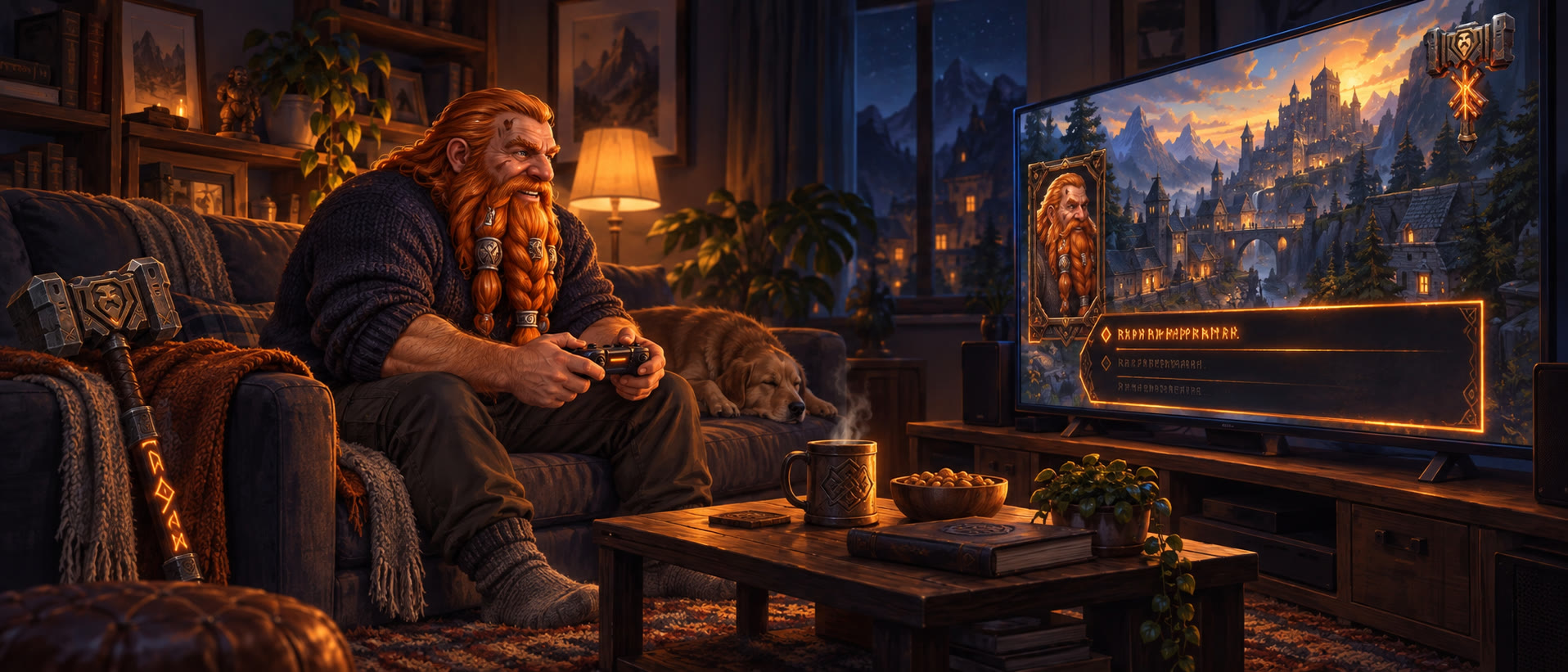
- Immersive Mode is here, and it is now the default for everyone - narration arrives as a full-screen scene built around the art, paced one sentence at a time. With voice narration enabled, the voice reads each sentence as it lands. Prefer the classic page of prose? Novel Mode is one toggle away in settings.
- Voice and pacing now work together - if you use voice narration, you no longer have to choose between it and paced reading. The words on screen follow the voice, sentence for sentence.
- Real dice for the Forge Roll - the old rolling-number animation is gone. Your skill checks now throw an animated 3D die that tumbles, bounces and lands on your actual result.
- The Academy Above & Below opens this week - a magic academy split across two realms, where one wing heals at a price and the other charges for heat.
- NPC Possession debuts in the Academy - step inside another character and act as them: their face, their name, their rank, and everyone's opinion of them. None of their mind.
- Custom companions - design a companion in the character creator alongside your own character: name, race, gender, age, personality, background and how they start out feeling about you. Their portrait is generated to match, and changes with their mood.
- Game Systems, out in the open - every experience now lists the systems it uses, you can filter the catalogue by them, and a new /systems page explains each one and shows whether it is live, coming soon, in development, or on the roadmap.
One Sentence at a Time
Until now, the game told you what happened in a box. A modal, a text panel, a block of prose that appeared all at once and asked you to read it while the world waited.
Immersive Mode replaces that box with a scene.
When you travel, when a world opens, when a conversation begins or ends, when you examine something, use an ability, rest, pick something up, or ask a companion to follow - the narration now fills the screen, built around the art we already hold for that place and those people. The prose does not dump; it is paced one sentence at a time, the way a story is actually told. And if you have voice narration enabled, the reading follows the voice: one spoken clip per sentence, so the words you see are the words you are hearing, exactly then.
Conversations get the same treatment. The engagement screen is now a full stage rather than a chat log with a picture beside it - the person you are talking to, the room you are in, your dice when they matter, and your rewards when you earn them, all in one place that holds still while you read. Quest progress shows up inside the narration where it happens, not as a sentence of story pretending to be a system message.
And when the dice matter, they are finally real dice.
The Forge Roll - the moment the game decides whether what you attempted actually worked - used to be a number spinning up like an odometer. It did the job, but it never felt like a roll. Proper dice have sat on our backlog for a long time. We took a run at them more than once, and every time the result looked like a toy or felt like a delay, so we put it back on the shelf rather than ship something we didn't love.
This week we got it right. Your Forge Roll now throws a single cast-iron die with forge-orange numbers across the screen. It spins, it bounces, it lands, and the number facing up is your roll, anywhere from one to a hundred. A roll that goes catastrophically wrong gets a ceremony all its own.
Immersive Mode is now the default for everyone, new and existing accounts alike. If you would rather read each turn as a page of prose the way it used to work, Novel Mode is unchanged and one toggle away in your settings - nothing about the classic screens has been taken from you.
Someone of Your Own Making
Custom companions are now a platform system, not a one-off. In the character creator you define a companion beside your own character: name, race and sub-race from the full All Forge roster, gender, pronouns, age, one of eight personality archetypes, a background, and a starting attitude towards you. A portrait is generated to match, and it changes with how they are feeling.
You create the companion; you do not own them. They are in the world as a real character with a personality, a history and a will of their own, and whether they come with you is a conversation, not a setting. Everyone you meet keeps their own opinion of you, and this companion is no exception.
The portrait work took more iteration than anything else this week, and what we learned from it is being applied to every portrait on the platform - a character who looks like the same person across every state they can be in, rather than a different face each time.
The Academy Above & Below
The Academy Above & Below is our largest world yet.
The Celestial-Infernum Academy fills two buildings joined by a working portal. In one wing, the Lowered Path, power heals and shelters - and the one who gives it pays the price. In the other, the Hoarded Warmth, rank is bought with someone else's cold, humiliation or loss.
You arrive as an adult apprentice, and to get anywhere you need an endorsement from both. That means walking both halls, learning what each one rewards, and deciding what you are willing to spend - and whose.
Over a hundred locations, more than fifty characters, and two schools of thought that each believe the other is the danger.
Wearing Someone Else
The Academy also debuts a new system: NPC Possession.
Some abilities let you step inside another person and act as them. It is not a disguise. When you possess someone, the world changes around you: your portrait becomes theirs, your character sheet becomes theirs, your name becomes theirs - and they are no longer standing where they were, because you are. You move with their body, their strengths and their skills. What you do not get is their mind. Behind their face, you are still you.
And the world answers to the face. The people around you treat you the way they treat the person you are wearing - their friendships, their rivalries, their rank, their debts. Walk into a room as someone that room trusts, and doors open that would never open for you. Walk in as someone that room is owed by, and you may find out why. Wearing a face buys you its relationships, for better and for worse.
When you are done, you let them go, and you are yourself again.
Like everything we build, it is a platform system rather than a trick for one world. Possession arrives first in the Academy, and the machinery underneath it is ready for any world that wants it.
Know What a World Can Do
Fable Forge has quietly grown a lot of systems. Until now you had to play a world to find out which ones it used.
Every experience now lists its Game Systems - as icons on its card in the catalogue, and by name on its detail page. You can filter the whole catalogue by system: pick Party Members, or Voice Narration, or NPC Possession, and see only the worlds that have it. Each system chip opens a short explainer, and the new /systems page lays them all out in one place.
Two things about that page we think matter. First, every system carries a status - Live, Coming Soon, In Development or Roadmap - and Live is not something we set by hand: a system shows as live the moment a public experience actually uses it. Second, it lists what is coming as plainly as what is here. Economy, Time Systems, NPC Schedules, Transformation, Infinite Worlds - they are all on the page with their status, so you can see the shape of where the platform is going without reading between the lines.
Back to the Anvil
A story told one sentence at a time, real dice when it counts, companions of your own making, and a new world where you can wear someone else's face. Plus a clear map of every system in the forge.
More of all of it, every week.
More soon. Same time next week.
Editor's note, 2 October 2026: this post has been edited since it was first published.