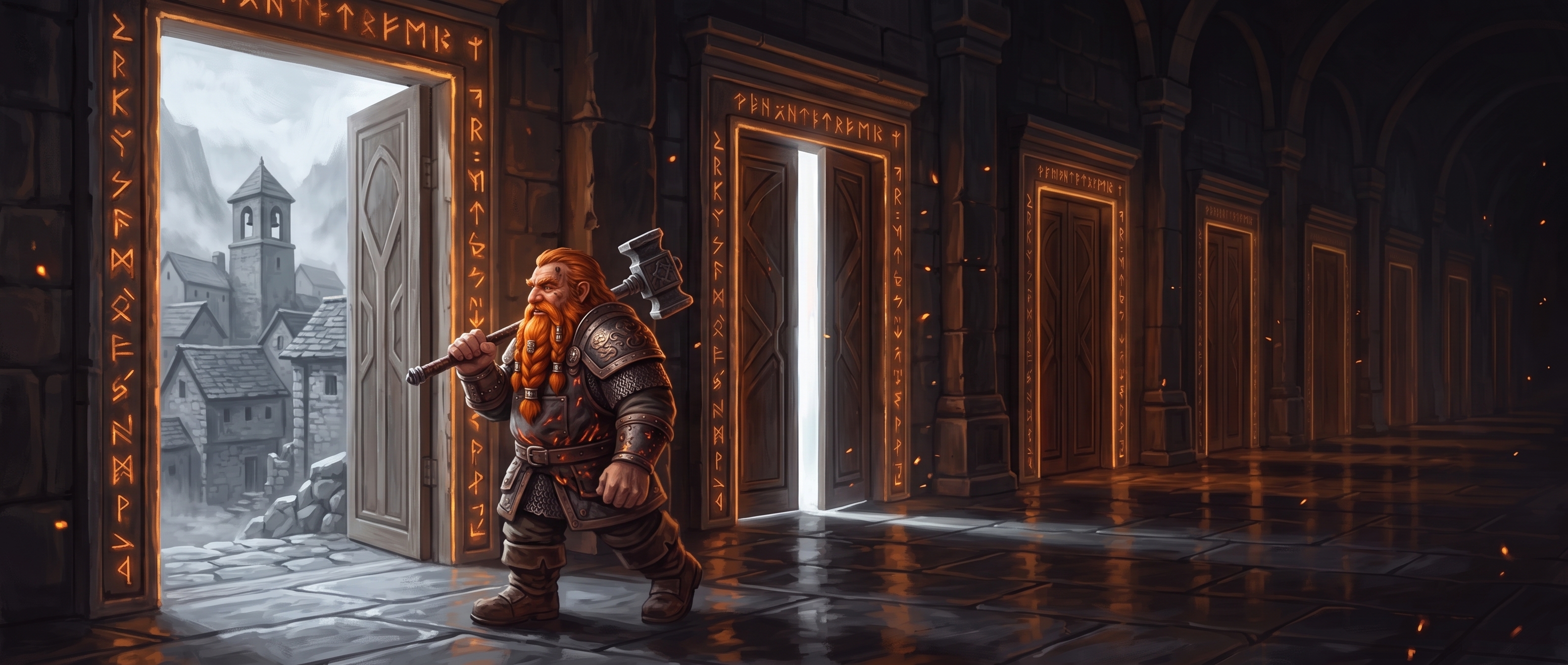
Chapter 1.5: The First Door Opens
Last time, we ended with a promise: soon, not months of waiting. We know what "soon" usually means in this industry. It usually means a quarter, an apology, and a roadmap slide.
Not this time. Chapter 1.5 is live.
The Short Version
For those who want the wares before the story:
- Bellstone is out now - a new fantasy world in the All Forge, set high on a mountain of stone that remembers everything that happens beside it. Traditional fantasy with a strange edge: truth quarried like ore, graded and traded, and a cast drawn from across the layers of the cosmos.
- A whole new set of character creator options - the seven mortal kindred of the All Forge, each with their own sub-races, each met differently by the world.
- More than twenty quests - alongside substantial work on how quest stages are detected, and on how characters lead you from one stage to the next, in world and in character.
- Our richest use yet of the systems we've already built - more mechanics, more combinations, better balance across every kind of character you can make.
- A few new minor systems, snuck in - nothing Chapter 2-sized, but quiet new pieces built to support the scope of the experiences we're now creating.
- Double Embers on every subscription tier and every one-off pack - with no change to gameplay costs. Same price, roughly double the playtime.
- Unlimited portrait generation for paid tiers - the cap is gone; portraits now simply spend Embers like everything else.
- A rebuilt purchase page - a proper explanation of the Ember economy, and real transparency on the playtime each tier buys.
- System hardening, quality-of-life work, and speed - including faster response times and improved narration generation.
- And behind it all: an evolving approach to content creation built to keep this cadence going - while the Chapter 2 forge keeps burning.
Now the long version.
Welcome to Bellstone
High on the shoulder of a quarry mountain stands a town built of stone that remembers.
Witness-rock keeps what happens beside it, and at dusk the walls play it back - a supper thirty years gone, faint as breath in the grey stone - and nobody stops to look. Bellstone cuts truth for a living: crews quarry remembered moments, assayers grade them, a factor prices them, and the Chapel files the ones nobody should own. One law stands over everything: cut-once. A moment lives in the stone that witnessed it exactly once. Quarry it well and you hold the only copy there will ever be. Ruin it, and it's gone from the world.
And in a cellar under Keeper's Row, the town has found something nobody has been allowed to look at, and everybody guards.
This is fantasy of the old, grounded kind - rope, timber, iron, oil-lamp and bell-metal, a working mountain and the people who make their living on it - with something genuinely strange running underneath. And the people are half the reason to go. Bellstone sits inside the All Forge, so its streets carry beings from across the layers of the cosmos: a winged, gold-lit pilgrim who climbs the high faces once a year reading the griefs the rock has kept; a deep-galleries engineer three hundred years at his work, who keeps a kettle on for crews though he has never once needed it himself; a verger nobody can quite account for. Alongside them, a town's worth of neighbours with wants, griefs, feuds, and forty years of things said quietly over ale.
No combat, no clock. You can't die out of this story, and you can't run out of time. What you can do is lose truths, and people, forever. The game will let you. That's the game.
Two very different beginnings - sign onto a quarry crew and let the town take you as labor, or wake in a room somebody else paid for, with the whole town being very polite about how hard it is watching you. Six crafts built for this world, from cutting and assaying stone to reading people the way keepers read rock. And a story that ends in a weighing, where everything you've learned, earned, shown, and destroyed decides what it weighs.
A New Way to Become Someone
Chapter 1.5 also ships a completely new set of character creator options: the seven mortal kindred of the All Forge - Forged Human, Dawnforged, Cinderborn, Oathforged, Rageborn, Loreborn, Veilborn - each with their own sub-races beneath them.
These aren't cosmetic labels. Bellstone notices who walks in. Every kindred is met a little differently - a Dawnforged signing onto a cut-once quarry crew gets a warmer welcome than most; a Veilborn is offered the town's practiced courtesy without ever being asked why - and none is barred a door.
Back in January we wrote about building a character creator that could be anything. This is that system stretching further than it ever has.
More Than Twenty Quests, and an Invitation
There are more than twenty quests in Bellstone, spread across seventy-odd individual stages. A few are handed to you. Most are not - they're found, in a conversation you chose to have, a wall you stopped to look at, a favour nobody asked you for. Finding and finishing them all is a genuine challenge, and we'd love to hear from the first person who manages it.
Getting there meant substantial work on two things, and both matter more than they sound.
The first is how we detect a quest stage. Deciding when a stage has begun, and when what you just did actually completed it, is one of the hardest problems in a game where you can say anything you like in your own words. Get it wrong in one direction and the story races ahead of you; get it wrong in the other and you do exactly the right thing and nothing happens. We've put serious work into reading what you genuinely did and meant, rather than waiting on a particular form of words. Play a stage sideways, in character, in your own voice - and it should still land.
The second is how you're carried onward. When a stage closes, something in the fiction should tell you what matters next - the person you're speaking to says it, in their own voice, for their own reasons, because they'd have reason to say it. That holds from stage to stage within a quest, and from the end of one quest into the beginning of another. It's the difference between a character telling you the factor at the Counting-House will know more, and a task list informing you of a name nobody has mentioned. The journal is there to remind you what you were told. It is never where you first learn something exists.
That second point is the whole philosophy in miniature, and it's why the work was worth doing: a quest should be something you're led through by people, not something you administer.
Quests also reach much further into the rest of the platform than they used to. Reputation opens and closes quest content. Gifts and gestures register, and are remembered. Discoveries in the world and the experience's own custom crafts feed objectives directly. Finishing something in one thread can quietly open a door in another.
But here's the part we care about most.
A quest stage is not a box to tick. It's a scene you're standing in. Bellstone is built so that how you play a stage matters as much as whether you clear it - the words you choose, the character you hold to, whether you tell the truth to someone who's earned it or someone who hasn't. Walk in as a careful Dawnforged who won't touch a face until it's shored twice, and the town answers differently than it answers a Cinderborn everyone is quietly watching. Not a different cutscene. A different conversation, a different reputation, and sometimes a different ending.
So the invitation is this: don't just complete Bellstone. Inhabit it. Stay in character when it costs you something. Say the thing your character would say instead of the thing that clears the objective.
Because that's the whole point of what we're building. Role-playing games have spent decades getting better at everything except the role-playing. That's the part we're here to give back - and with what's now possible, it can be like nothing you've played before.
Pressing the Moulds Harder
A quieter confession to go with the loud one from last time: our earlier experiences didn't use everything our own engine can do. Not close.
Bellstone does. More mechanics in play, used more liberally. More interesting combinations - reputation feeding dialogue, gifts and gestures that characters actually weigh, custom crafts wired straight into the Forge Roll, discoveries that pay out in more than experience points. And a deliberate balance pass across every kind of character you can build, so that whoever you choose to be, the world rewards how you do things - not just the one obvious build.
We did say Chapter 1.5 wouldn't bring new systems. That turned out to be almost true. The major systems are still Chapter 2's to reveal - but we snuck in a few new minor ones along the way, quiet pieces built to support the scope of the kinds of experiences we're now creating. You may not spot them by name. You'll spot what they let the world do.
There's also a solid layer of hardening and quality-of-life work under all of it, and some of it you'll feel immediately: faster response times, and better narration generation. Less waiting between your action and the world answering - and a world that answers better when it does.
The Machinery Behind the Curtain
Now the part that matters more than any single release.
Our approach to content creation is constantly evolving - and this chapter forced the biggest evolution yet. The first problem we ran into was the oldest one in development: do we focus on new content, or new systems? Every hour at one anvil is an hour away from the other.
But being the industrious Dwarven Forge Masters we are, we stopped treating it as a decision and started treating it as an engineering problem. If the bottleneck is choosing, don't choose better - build the thing that removes the choice. How do we engineer a solution that lets us do both at the same time?
We have the schematics for that solution now. It's early days - but the prototype tools we're already running are very promising, and you're looking at their first output: Bellstone came through that machinery. And it's already at work on what comes next.
What does that mean for you? Short term: more content, quicker. Medium term: more content, quicker, with new systems appearing regularly alongside it. Combat, new ability types, the mechanics we haven't named - none of it waiting in line behind the next world, and no world waiting in line behind it.
More on the tools themselves in a future post.
Double Embers
We've taken a hard look at our platform economy - how Embers get consumed across the platform, and how long a balance actually lasts. The result is the best kind of update: every subscription tier and every one-off purchase pack now grants double the Embers - with no change to gameplay costs.
Same price, roughly double the playtime. We've also rebuilt the purchase page: a proper explanation of how the Ember economy works, and real transparency about how much playtime you can expect from each tier.
One change did come out of the rebalance, and it's one we think you'll like: portrait generation is no longer capped on paid tiers. Generate as many portraits as you want, whenever you want - your character's look is yours to chase. To keep that fair for everyone (and to keep the wider economy healthy), each portrait now spends a few more Embers than before. With your Ember grants doubled, you still come out well ahead - and without a ceiling in your way.
A word on why Embers exist at all, because we'd rather say it plainly. FableForge has complex system and authoring requirements, and we intend to keep pushing toward the most cutting-edge AI features available. The Ember model is what lets us always give you the best-quality version of the game - rather than the cheapest one that fits under a flat fee.
But we also want you playing - as much as possible, getting the most from every dollar. So we doubled your Embers, and your potential playtime with them. And that value compounds from here: as the content library grows, those same Embers stretch across more worlds. Beyond new worlds, Embers are also what will fund some feature plans we're keeping under wraps for now. We think you'll like where this goes.
Back to the Anvil
That's Chapter 1.5 delivered: a new world, a new way to build a character, quests worth chasing, a doubled wallet, and the machinery to keep it all coming.
One last milestone before we go. Fable Forge has been in early access for a little over three months - but we just quietly turned one year old since development began in full. One year, from a blank anvil to a playable platform in full production swing. That pace wasn't an accident, and it isn't slowing.
You will be surprised what we do with year two.
The Discord is where the conversation lives: discord.gg/sYshVvXYFC. Come tell us what you find in Bellstone - and start guessing what's behind the next door.
The next one is closer than you think.