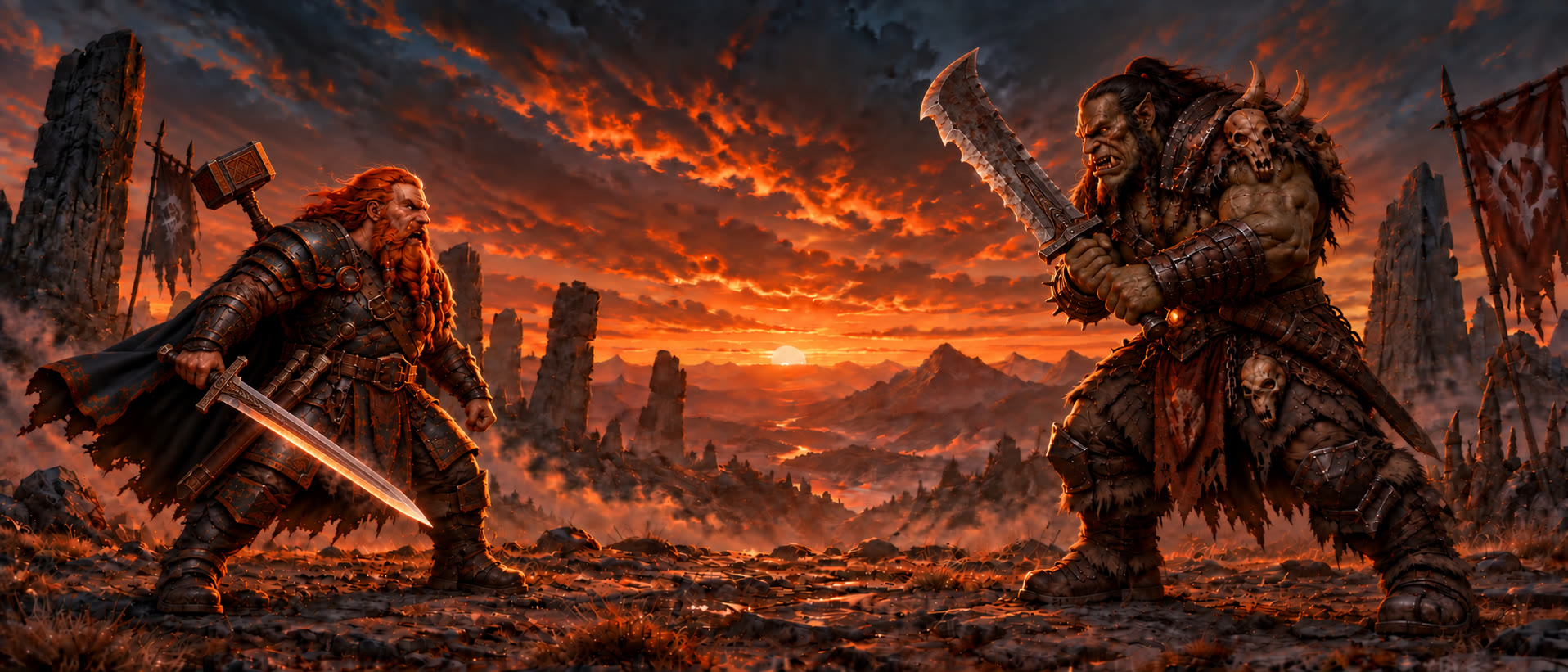
Chapter 1.5: Readying for Battle
Last week we told you combat was in its final stages. This week we can tell you it is built.
What we cannot tell you is that it has shipped.
The Short Version
- No platform update again this week - the second in a row. Next week that changes.
- The combat foundation is in and working - the whole engine, end to end: how a fight starts, how a turn resolves, what a beating leaves behind, and what the world remembers afterwards.
- The fight runs in Immersive Mode too - the combat screen and its windows have been rebuilt for the full-screen mode, so a fight looks and moves like the rest of the game rather than a system bolted to the side of it. Novel Mode's fight is untouched for anyone who prefers it.
- Now we weave it into something to play - what is left is the world the fighting happens in, and the balancing that only ever comes from playing it over and over.
- So instead of an update, here is the system - the whole of it, below. Brawls that end with someone on the floor and fights that do not. Initiative. Called shots. Mercy. Looting. A world that remembers who swung first.
- Next week's update is already built and waiting - your sessions said to be private in plain words, the interface's speed back, three fixes you may have noticed, and a systems page that keeps itself honest. None of it is combat, and all of it goes out together.
Two Quiet Weeks
We shipped something every week for well over a month. Then we stopped twice in a row, and that deserves plainer speaking than "combat is coming".
So, plainly: every stage of the combat engine is built. It was built in stages, and each stage was played properly - one case at a time, with everything the play turned up fixed before the next stage began. The automated suite that guards the platform crossed eleven thousand checks along the way. Fights start. Turns resolve. The dice behave. People fall over and stay fallen. The world afterwards is not the world before.
That is the foundation, and in an AI RPG the foundation is the hard part: a fight has to be a set of rules the dice can settle and a story the narration can tell, at the same time, every single turn.
It is also not the part you touch. Next week the platform moves again - not with combat, but with everything else that piled up behind it while combat was being built.
What "Readying for Battle" Means
We built combat on Fable Forge's classic screens on purpose.
Novel Mode - the original page-of-prose reading mode - has panels and modals we already trust, and a fight is the worst possible place to be debugging a new interface at the same time as new rules. So the rules got the old furniture, deliberately, and every argument about how a fight should work was settled without an argument about how it should look.
Then we went back and did the looking properly. Immersive Mode, the full-screen mode that became the default two weeks ago, covered every surface in the game except one, and combat was the one. That gap is now closed. The fight has been rebuilt as a proper Immersive stage: the room you are fighting in, the people in it, the turn order, your dice and your damage, all in one place that holds still while you read, with the same transitions in and out as everything else you do. And as with every other screen, Novel Mode's version is untouched for anyone who prefers it.
So the engine is in, and it now looks like the rest of the game. What is left is the part with a story in it - the world the fighting happens in, the encounters worth walking into, and the balancing that only ever comes from playing the thing over and over until the numbers stop being interesting and the fight starts being interesting.
Last week we said very soon, and we meant it. We are still not putting a date on it, because what is left is the part you actually play.
In the meantime, here is what you will be able to do with it.
How a Fight Starts
In more ways than you would expect, and hardly any of them is a button marked Fight.
You can start one from a character's card - attack, or start a brawl instead, or bring your party in with you. You can start one from inside a conversation, where choosing to attack throws a two-dice contest first: whoever wins it moves first, and that is the whole difference between a fight you chose and a fight you merely began.
You can also start one without meaning to. Describe what your character does, and if what you wrote reads as an attack, the game asks whether you meant it before it commits you. Threaten someone and you may get your answer back and then a question: this is turning into a fight, is that where you are going? The other side has the same freedom. Someone who has heard enough can swing first, and a hostile who knew you were coming can ambush you on arrival, with the dice thrown after you have read where you are.
And when a fight cannot happen, you get a sentence instead of an error. They are not here. You can't fight them. There's no one to fight here. That sounds like a small thing. It is the difference between a world with rules and a piece of software with a problem.
Not Every Fight Is To the Death
A brawl and a fight are different things.
A brawl ends with someone on the floor, not in the ground. Reach for a killing weapon in the middle of one and what happens depends on the world you are in: the blow lands as a knockout anyway, or the move is refused outright, or the brawl stops being a brawl - which is its own kind of story. A fight that started deadly never softens back into a brawl.
And you cannot accidentally murder your own story. Anyone a quest you have open still needs will be knocked out rather than killed, however the dice fall. Finish that quest or walk away from it, and the protection lifts with it.
The Turn, and the Roll
In the fullest worlds, everyone shares one queue, shown as a turn order you can read, and anyone who beat you to it acts before your first turn - so a fight can be half lost before you move. Simpler worlds keep it to a trade: you act, one of them answers.
Every attack is a Forge Roll, the same hundred-sided die you have been throwing at locks and lies all along, with your move's attack set against your target's defence, their guard and their gear. How well you rolled is how much it hurts: a forge critical, a clean success, a partial, a failure, or a catastrophe, scaling the damage from devastating down to nothing at all. Armour and a good guard make a blow harder to land. They never soften one that does.
Your options are not a fixed list of three. They come from you, from what you are carrying, and from the room you are standing in. Change your gear and you can do different things, because the moves and the numbers ride the equipment - which is why disarming someone takes their options away along with their weapon. The room lends moves to everybody, and your opponents will reach for them too, though the table only gets thrown once.
Alongside your move sit two boxes: what your character does, and what they say while doing it. Both are narrated as your own, in your own voice, with the move. Or skip, and say nothing at all - a skipped turn stays silent whatever you typed, and what you typed waits for the next one.
Aim Somewhere Specific
Some moves let you choose where to hit.
A called shot is harder to land, and the penalty comes off the roll and nothing else - but a blow that does land leaves a mark that stays. Go for the legs and a fighter comes out of it hobbled, which is a condition with a consequence: whatever else they can still do, they can no longer run away.
That is the shape of every condition in a fight. A move may empty someone's energy or their focus rather than their blood, and what is left standing is not the same person: dazed, confused, incapacitated, restrained. A hold shows on screen with the rounds left on it, for every fighter in the fight and not only for you. None of this is a status bar that clears when the fight does. It is what happened to a body, and it carries.
Losing
Defeat is not one thing either, and which one it is belongs to the world you are in.
You may simply stay down where you fell, with everything that means for whoever is still standing over you. You may come round somewhere else entirely, at the bottom of every pool you have, with whichever companions sat that fight out. Or, in the hardest worlds, that is where your story ends - and never, ever in a brawl.
Afterwards Is Half of It
The fight ends. Nothing tidies itself away.
Bodies stay where they are. Conditions stay on the people wearing them. What you do next is the interesting part: wake someone, give them first aid, tie them up, gag them, untie them, ask them questions they would rather not answer, take what they were carrying one piece at a time, let them go - or finish it. A companion who went down can be brought back up from your party panel.
Mercy is a real option with a real outcome. Someone you beat and then spared may end up walking beside you.
And the world does not forget any of it. Everyone who was in that fight keeps their own memory of it. So does anyone who watched. The place itself remembers what happened there, and how people think of you moves with it, so the next person who greets you is greeting someone who did that. This is the part only an AI RPG can do: not a flag somewhere saying you won, but a room full of people who each remember it their own way.
Your Sessions Are Private
Everything from here on is built and waiting for next week's update. It starts with something that is less a feature than a promise we wanted to be certain we could keep.
Your sessions are private. Nobody here opens or reads them. Everything you type and everything the world says back is encrypted in transit and encrypted at rest, only the game itself processes it, and the people who work here have no tool that would show them your session. The only exceptions are you asking us to look, or the law requiring it, and any such access is written down.
Next week that stops being something you have to take on trust and becomes something the site says out loud. The privacy pages are rewritten around it, and they spell out exactly which parts of a session leave us and where they go: the AI partners that generate narration, voice and judgement, and our team's Discord, where the feedback and bug reports you send us land. Our analytics were already kept away from anything you type, and they are being tightened further, so that not even the labels you click can carry any of your story.
And if you never read a privacy page - most people never do, and we do not blame you - you will start noticing a small quiet lock in the places where you type. That is all it is. A reminder, where the typing happens, that what you write there is yours.
Speed, and the Small Things
Our 15 September release made the whole interface feel slower. Menus, modals, narration, a general choppiness - not the game thinking, just the game feeling heavy.
We did not guess at it. We built the releases either side of it, profiled them against each other until we could name what changed, and wrote a staged plan with a way back at every step. Those stages go in one at a time, each one played and felt before the next begins, because performance work nobody verified is just churn with extra confidence. The first of them reaches you next week.
Three smaller things travel with them.
Anything that fades in on Chrome blinks out for a single frame just as the fade finishes - travel windows, narration windows, the home page grid. Firefox never does it. It is a bug in the animation library we use, since fixed upstream; we are carrying our own fix until we can take theirs, and it arrives next week.
If you zoom your browser in, the navigation slides off the end of the header bar, and the tapered edges of the page clip content at the sides. On a signed-in laptop at ordinary zoom, "Your account" is already being cut in half. Both are fixed and land in the same update, with the navigation giving way to the menu button before it can overflow rather than after.
And one you would never have seen, because we caught it first. As our worlds grew, a single internal lookup grew past a database limit, and points of interest started refusing to answer. It will ask in batches from next week. It is a dull fix. Dull fixes are what keep a Saturday evening intact.
The Roadmap Starts Telling the Truth
Two weeks ago we put up the /systems page: every game system, what it does, and whether it is live, coming soon, in development or on the roadmap.
It is a list inside our code, which means it only ever tells the truth on release day. Next week it moves into our database, so a new system, a changed status, or another world adopting one appears on the systems page, the roadmap, the catalogue filters and the experience cards the moment it becomes true, with no release in between.
Combat is on that page today, and it reads Coming Soon. We do not set Live by hand - a system goes live the moment a public world actually uses it. So that word will change by itself, and when it does, you will know before we have finished writing about it.
It is a good page to watch.
Back to the Anvil
Two weeks without an update, an engine that fights, a fight that now looks like the rest of the game, a world being built for it, and a pile of everything else ready to go out next week.
The blade is quenched. Now we fit the handle.
More soon - and next time, with the gloves off.