Published
Chapter 2: Pull Up a Chair
Characters now come over to talk, know how they know you, and remember what you just said
The people in Fable Forge now come to you. After the opening scene, someone in the room may walk over for a word. A stranger greets you as a stranger, someone who knows you says how, and if you close a conversation and open it again a moment later, they still have what you just said.
Around them, the first few minutes get lighter and the rest of the game gets fairer: fewer pop-ups before your first move, a short recap when you come back, free Embers that wait for you, and your Ember back when a move fails to go through.
The Short Version
- Characters come over to talk - out with this update. After the opening, a character may walk over with a Talk / Not now choice; if nobody does, ready-made first moves point you at your story.
- People who know you - first meetings are first meetings, people who know you say how, a conversation you reopen straight away is remembered, and a quest you finished is known as settled and paid.
- Plainer, shorter talk - characters answer what you asked first, in about forty-five words instead of more than a hundred.
- A lighter start - one tip instead of a thirteen-step tour, your chosen hero kept through sign-up, and a "Previously…" card when you come back.
- Embers that wait for you - free Embers you don't use are kept for up to a week, running out saves your place and tells you when more arrive, and your first purchase comes with 600 extra Embers.
- Fairer when something breaks - a move that fails before it is saved costs nothing, and a slow or failed move tells you so instead of sitting on "Still writing…".
Someone Comes Over
Starting a new story used to end on a quiet room and a blinking cursor. Now the opening scene ends by pointing you at the first step of your quest - a place, an object, a notice, or your own situation - and then the room reacts to you.
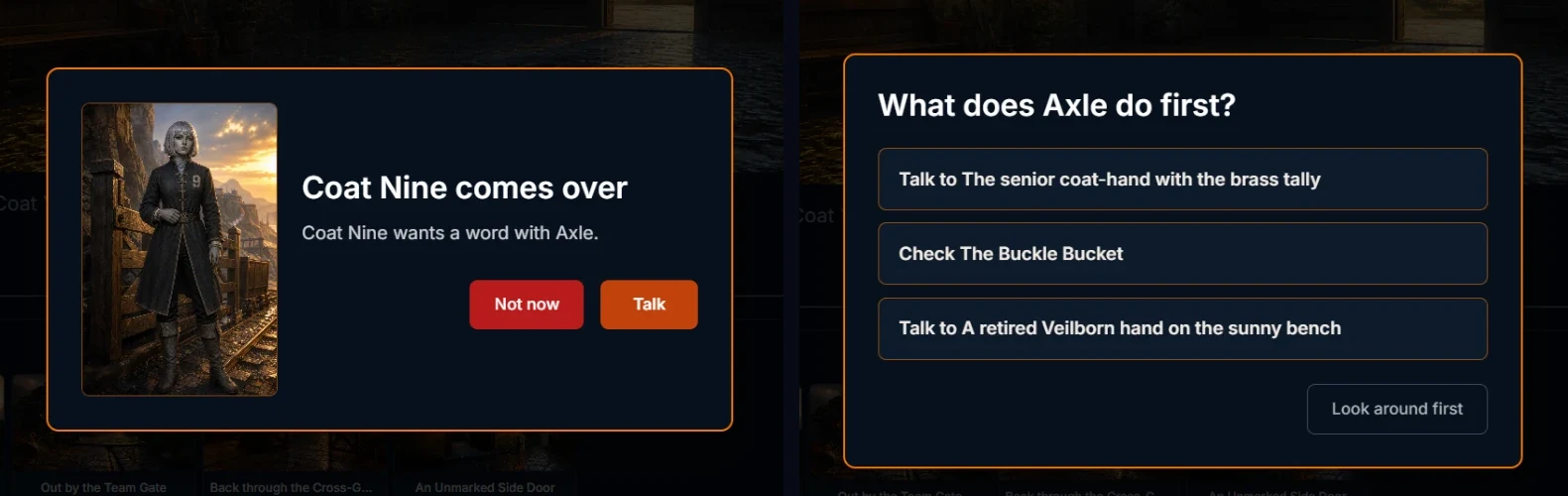
In about half of our starting points, the first step of the story is to talk to someone already standing there. Now that person walks over. A window shows their portrait, "Coat Nine comes over", and two buttons: Talk, or Not now. Not now is free. They won't ask again, and they stay in the scene for whenever you are ready.
Everywhere else, and after a Not now, a second window asks what your hero does first and offers up to three moves built from your quest and the room: talk to someone, check something, or head for an exit. The first is always the way into your story. Look around first is free, and closes the window with nothing spent.
None of this replaces typing. It just means nobody starts a story wondering what they are meant to click.
People Who Know You
A conversation in Fable Forge is only as good as what the other person knows about you. This update changes who knows what.
A character you have never met now greets you as someone new, with no invented shared past. A character who knows you from the start of your story says how, in a line written for each of them: by name, or only by face. If you lose a fight and come round somewhere, the people there know you were brought in hurt.
Close a conversation and open it again straight away, and the character still has the last few things you said while their memory of the talk is being written. If writing that memory fails, they keep a plain one instead of nothing.
Finish a quest and the people tied to it know it is settled: which way it went, what it paid, and that nothing more is owed. Before, a finished quest could slip out of what people knew, and a player who had been paid could be told for dozens of turns that the money was still owed.
And the pronoun you choose in your world's character creator now reaches the conversations, memories, fights and summaries written about your hero. Tell a character how to refer to you, and that character will.
Asking the Way
Ask a local where the theatre is, and you should get directions, not a blank look. Every public place in our worlds now carries a short note built from the map itself: what it is, which quarter it sits in, what is next to it, and how to walk there using the exit names you can see. A closed way is described as closed, with the map's reason. People know their own quarter and the ones beside it, and every world has a few landmarks everyone knows. New in Newfield follows once its map has quarters.
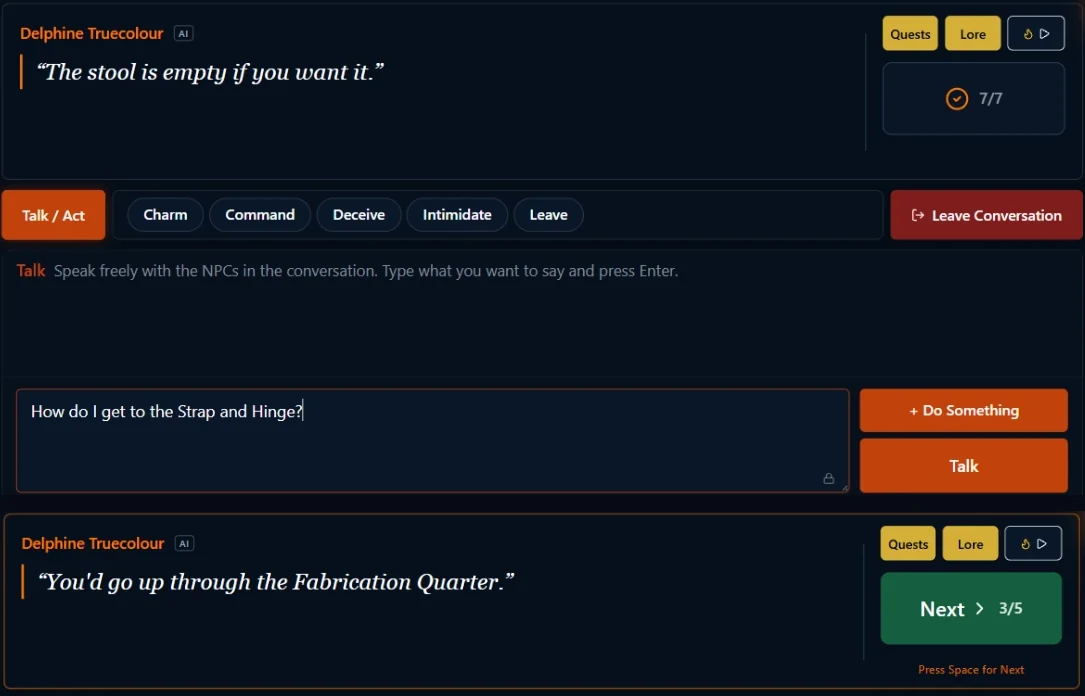
Before a character says they have never heard of something, the game now checks what that character actually knows, so a person holding a fact about a place uses it.
Ordinary words also stop being mistaken for names. "Alright", "Done" and "I'll" were sometimes answered with "that's no name I know". Across more than a thousand test messages those mix-ups halved, while every one of fifty-one invented names was still caught, and in a blind-judged live test all thirty-three ordinary lines were answered normally. There are still a few left to find, and we are on them.
Talking Like People
Characters used to answer a simple question with a speech: more than a hundred words, five sentences, half their life story, and you were often "the stranger". We changed how every character and the narrator are told to speak, then replayed a hundred and thirty real moments from our test games ten times each, judged blind.
A reply now averages about forty-five words instead of a hundred and eleven. Characters answer what you asked first seven times in ten, up from four. "The stranger" went from half of all narration to one line in twenty-five, and small talk that drifted back to business dropped from half the time to about one in eight.
A Stranger Worth Following opened on Friday, as we promised. Its people got the same treatment: every character in it was rewritten to play as a person rather than recite their notes.
Play A Stranger Worth Following
Seen and Judged
How people feel about you was always meant to depend on what they see you do. In a scene with several people, though, everyone was taking the last person's reading. Now each person who sees something is judged on their own, by what the act means to someone in their place.
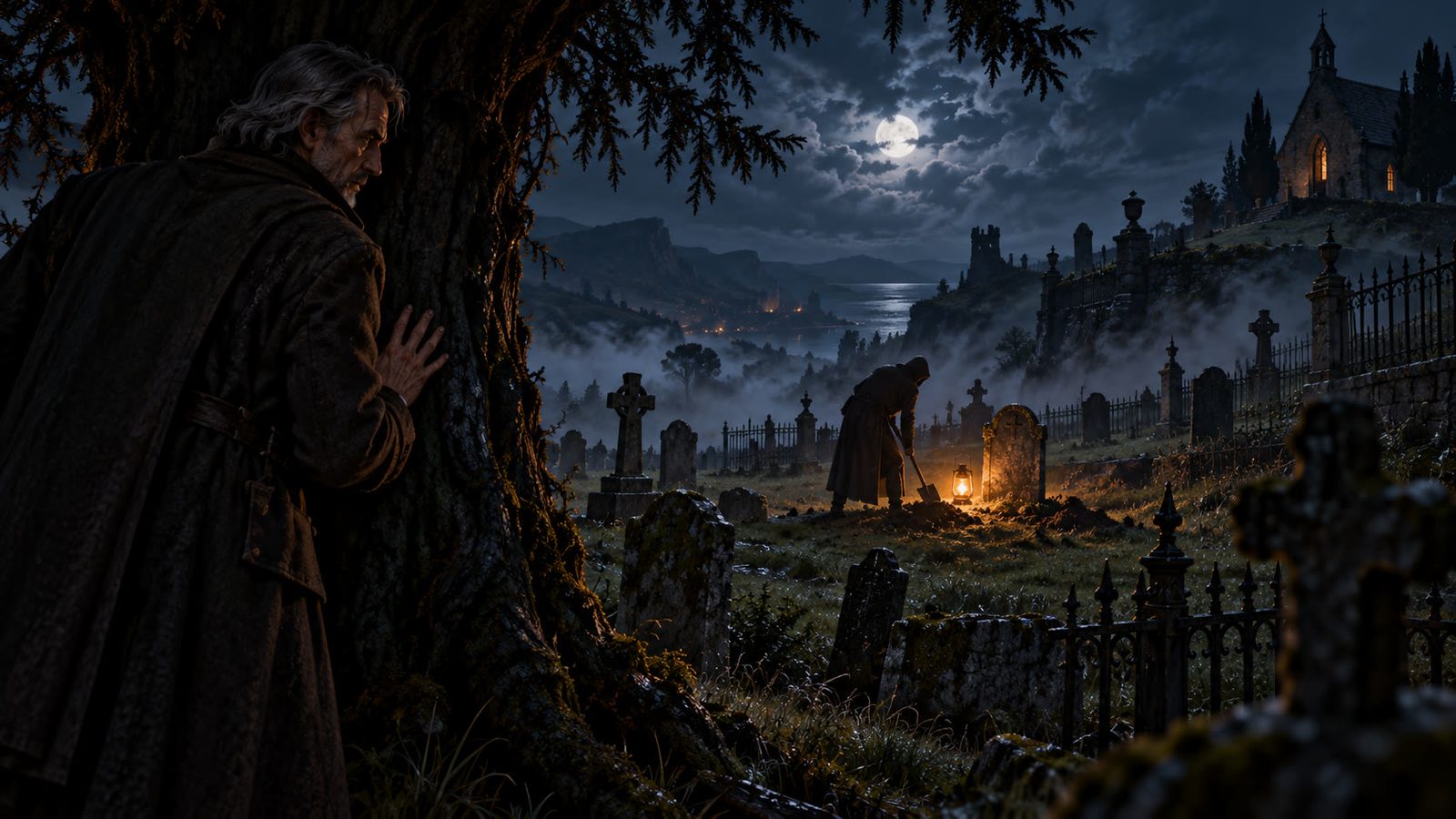
In our test, a man watched a player dig up a grave, bribe him, lie to him and shove him, and stayed Friendly. After the fix, the same scene took him to Neutral. People further from the action still react less than they should, and that is the next part of this work.
The same honesty reaches your party. Ask someone to join you and they now tell you why not: they don't know you well enough yet, they won't walk with you after what you did, or they side with someone against you. In The Dead Pay Half, some answer in their own words: "You've got my name on your paper."
Coming Back, and Running Out
Come back after eight hours or more and a "Previously…" card catches you up: up to five things that happened, where your hero is and who is with them, and your next step. One button, Keep playing.
Running out of Embers is now a bookmark rather than a wall. The window says your story is saved, shows where you are, who is with you and your next step, and tells you when your fifteen free Embers arrive, on your own clock. Leave a game and a short card says how many Embers you have left and when more come.
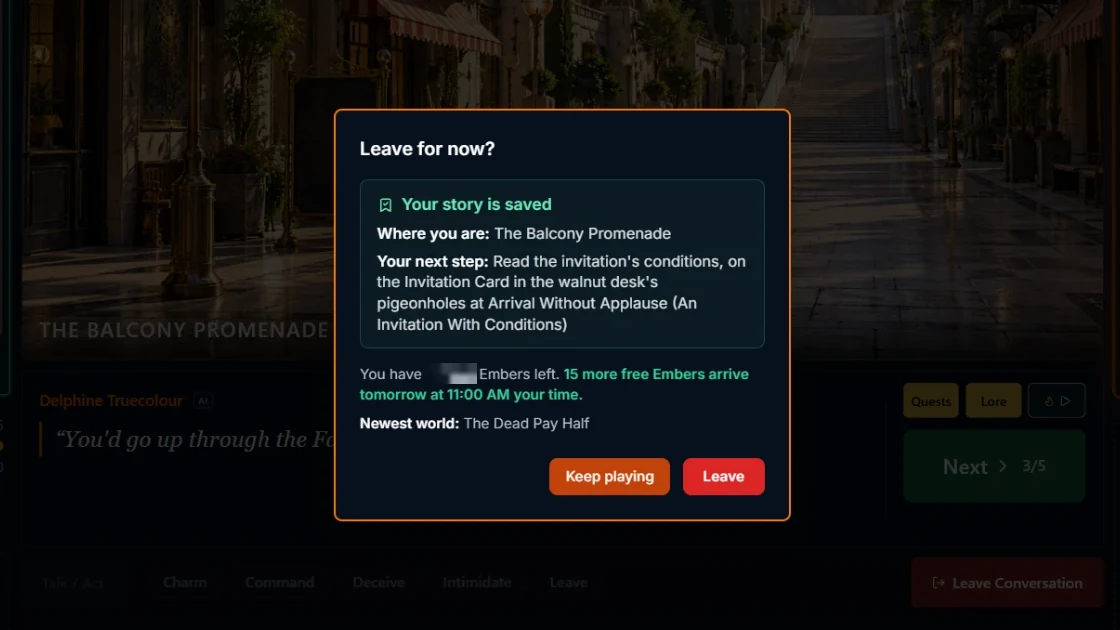
Free Embers you don't use are now kept for up to a week instead of disappearing each day. And your first purchase of any pack or plan comes with 600 extra Embers, once per account.
When something goes wrong, it costs you less. A move that fails before it is saved now says "That turn didn't go through. Nothing changed." and gives the Ember back. A slow story says it is taking longer than usual and trying again, and after fifteen seconds you can leave for the home screen. If a new game's opening scene never arrives, the Ember comes back and the game tells you.
Plain Words, Round Two
One Ember promised more plain words, and here they are. After the quest log, we rewrote the words you meet most: more than six thousand descriptions of places, exits, objects and locks, and more than five thousand results of the things you do, from the outcome of a challenge to what you learn from reading something, in every world but The Ruins Still Obey, which is next. In Bellstone, the average sentence went from twenty-seven words to fourteen. Every name, every lock and every rule stayed exactly as it was.
A Lighter Start

A lot of small things stood between a new player and their first move. Most of them are gone.
Pick a hero before you have an account, and that hero is waiting for you after you sign up. The game screen starts loading while you type your hero's name. The automatic thirteen-step tour is now one tip on the action panel, with Show me around if you want the full tour, and the Ember explainer that interrupted your first paid move is now a one-line note. In The Future Requires Maintenance, every start's first win comes much sooner: the shortest route to it dropped from as many as forty-seven moves to twenty-two at most.
If you want to see what a first session looks like before you start, the new first-session walkthrough shows one real session in The Dead Pay Half, turn by turn, with every screenshot marked as narrated by the AI or enforced by the engine.
Fights
Brawls can now be lost. When an opponent's blow takes your Energy to zero, you are knocked out and the fight is lost; spending your own Energy to zero still lets you act. Each move's cost now comes off the fighter who paid it, shown under the narration, and a beaten opponent's bar stays down.
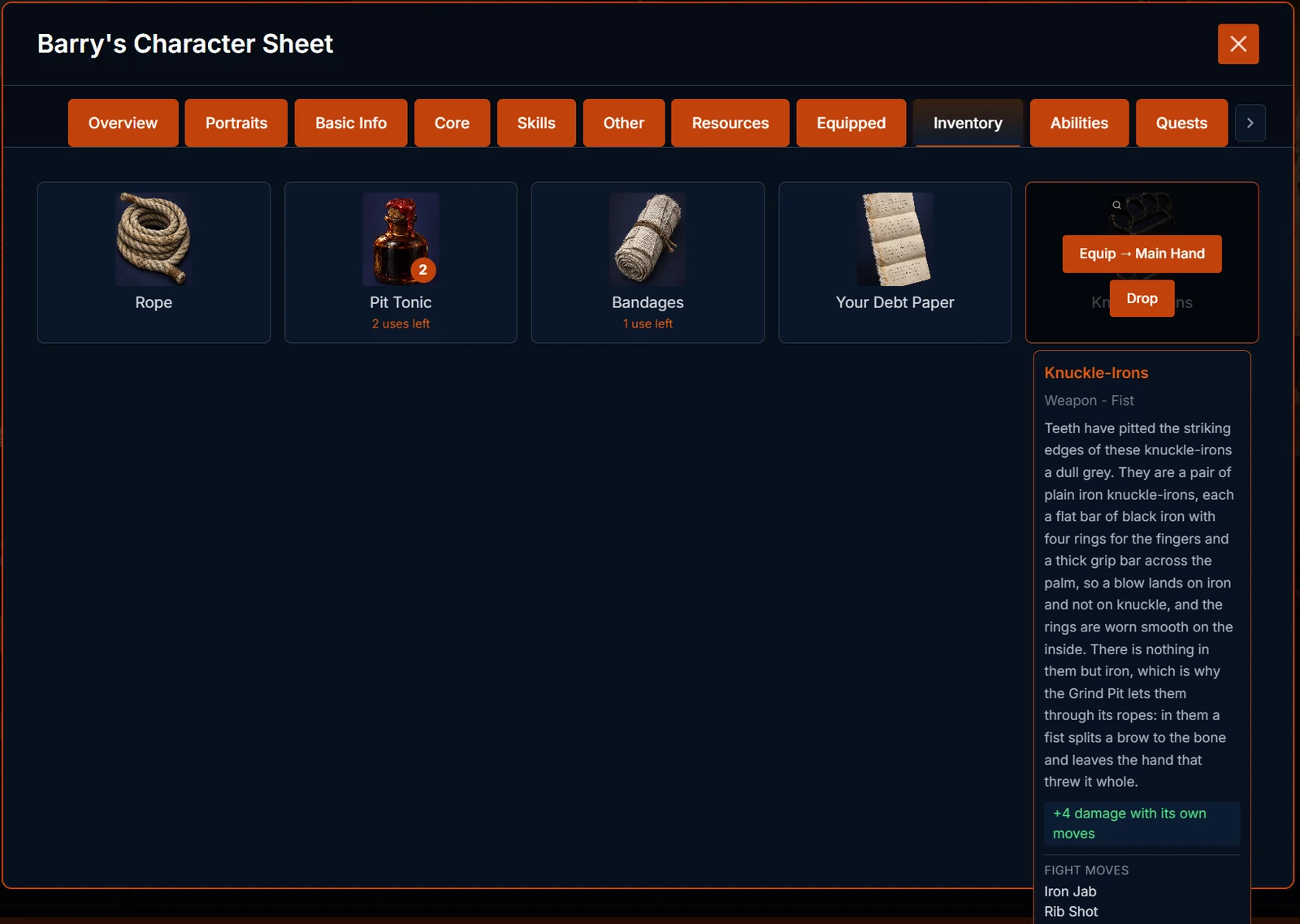
Knock someone out and they stay down for the turns the world sets, and the game tells you when they come round. From someone who is down, you can take several things in one go. And an item's fight moves, how often you can use them and what they need now show before you equip it, with a warning if equipping it would cost you moves you rely on.
Knowing It's AI
Every character in Fable Forge is played by AI, and we want that to be plain. Character names now carry an AI tag, a quiet notice says so when you start playing and once an hour after, and if you ask "are you an AI?" outside the story, you get a straight yes. If a typed line suggests you may be in distress, a card steps out of the story with free helplines for your country. Picture requests that name or describe a real person are turned down before any Ember is spent. Our new safety page explains all of it.
Smaller Changes and Fixes
- Buying Embers in Safari - the button seemed to do nothing → checkout opens
- The out-of-Embers window on a laptop - shown at about 60% size → full size
- A paid check's result behind a slow story - stuck on "A moment passes…" → the result shows at once
- The object window - closed by itself, Take greyed out until you had read everything → stays open, Take works at once
- A game that didn't finish starting - used a game slot and crashed when opened → frees its slot after ten minutes and says what happened
- The Academy Above & Below's ready-made heroes - opened the full character creator → start a game
- The sign-up code step - a click outside the box wiped it → only the X closes it
- Translating a page in your browser - could crash the purchase page → fixed, with a safety net across the site
- Tutorial buttons in shorter windows - could fall off the screen → stay on screen
- Report a Problem - had stopped sending → sends again, in a bigger window
- Narrower windows - black bars above and below the game → the game fits, with a footer of tips, the world's name and your next step
- The home page - no news → the two newest posts under the main banner
- For developers of AI games - a new write-up on how we write the next scene early: Instant Scenes
Back to the Anvil
Chapter 2 gave this AI RPG combat, a map and one Ember a move. This update gives it people: ones who come over, know how they know you, remember what you just said, and notice what you do.
Pull up a chair. Someone will be along.
More soon - save us a seat.