The Door That Takes You Twice
- story-driven
- Difficulty: intermediate
- About 1200 min
- solo
- Game Systems: Party Members (New), Higher Beings (New), Ambient Audio (Live)
- house-of-delights
- warm-and-uncanny
- hospitality
- no-combat
- all-forge
A great house stands through a thin place in the world, and what it offers is plain: an evening for beings of cosmic power, in a house where consequence does not apply. Nothing done here follows a guest out, and no one met inside is invented — each is drawn faithfully from something real. Long tables of dark wax-polished wood, candle-amber light, a copper pot never found empty; tender floors above, ember-lit ones below. There is a price at the door, and it is named there.
A House Where Consequence Does Not Apply
What the house is for
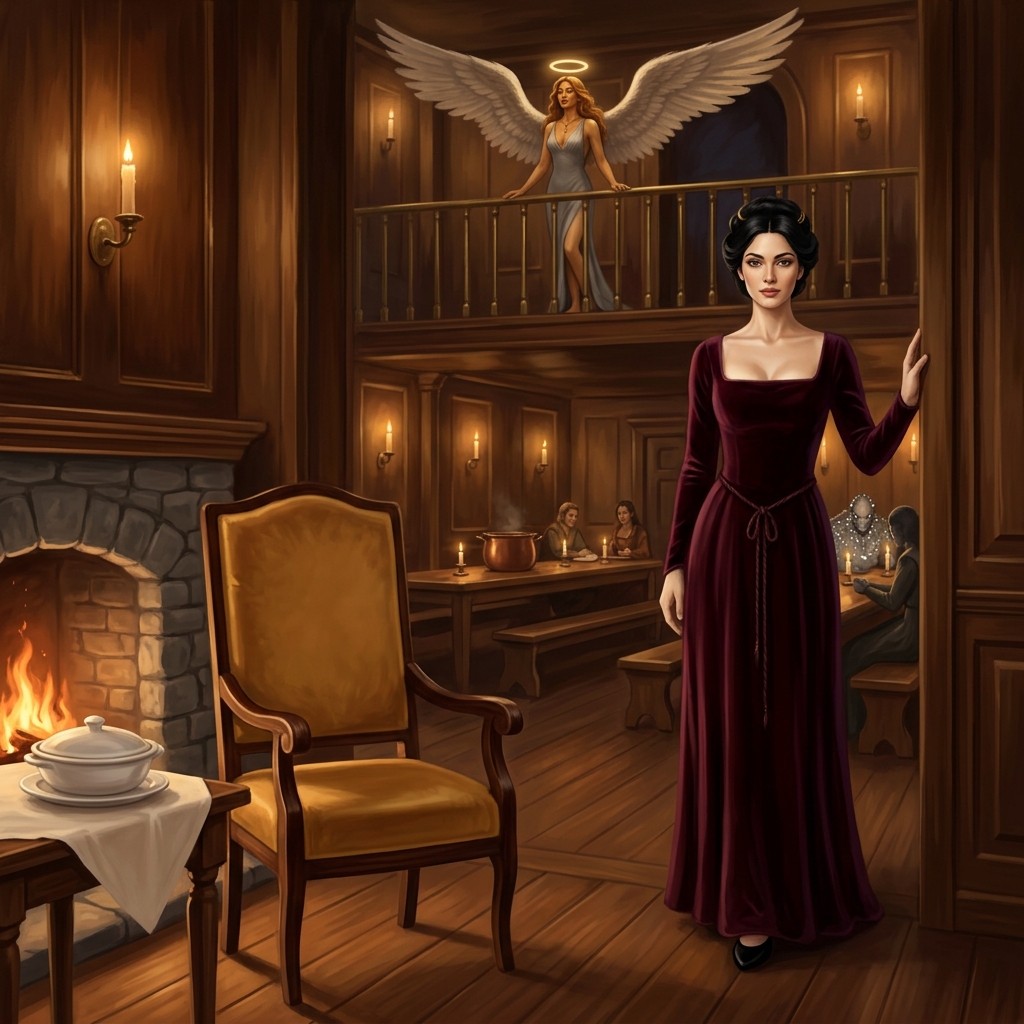
A house stands through a thin place in the world, and every door it has opens into one panelled hall of dark wax-polished wood and worn brass. What it offers is plain enough to say at the threshold: an evening in a house where consequence does not apply. Nothing done here follows a guest out of it, and nothing done here is pretended at — no one you meet inside is invented. Every person at these tables is drawn faithfully from something real, and answers as that thing would answer. There is a price at the door. It is known law, and nobody in the building pretends otherwise; it is named plainly at the threshold, when you are asked to agree to it, and not one moment before.
A plain word for a name
Inside, the Book of Plain Words lies open on its waxed stand, and the custom is older than the argument against it — you take a house-name, a plain word worn like a mask that hides nothing. The staff wear theirs. So does the hostess, who is in every room of the house at once — which is one of the famous things about it — and who has never once raised her voice.
Who finds it, and who comes back
Two kinds of guest cross that threshold. The mortal kindred of the Centrum arrive once, and the arriving is the whole achievement — there is no road to a thin place, and what carries a mortal to this door is luck, or craft, or a rare chance, or an ambition that would not be talked out of. The higher kindred travel between worlds as a matter of course, and for them the house is simply a stop they keep returning to: they know what the door asks, they know what the lower floors are for, and they know which of those is the more dangerous thing to know. The door does not rank them.
Warm at the middle, and it goes both ways
Beyond the hall the great room opens: long tables of dark wax-polished wood, honey and candle-amber light falling in pools, a copper pot that has never yet been found empty, music pooling down from the gallery's worn brass rail. Above, the floors climb into dawn-gold and borrowed skies. Below, they go ember-red and plush, where hunger is named aloud and never guessed. The stair asks nothing of you either way; what was paid at the door bought every floor.
The chair by the fire
Off the great room there is an alcove, and in it one high-backed chair of honey-gold velvet with dark polished wood arms, facing a small grey fieldstone fireplace. It is the most famous chair in the house, and it is empty. At its arm a covered dish of white-glazed earthenware waits under fresh cream linen and goes cold where it stands. The staff pass the alcove the way one passes a laid table before the evening begins, and nobody mentions it.
Take a plain word for a name, take a place at the long table, and let the house begin serving you.
On offer tonight
- An evening on which nothing you do follows you out of the building.
- The body, the mind, and the stranger pleasures, served on all four bands and named like dishes.
- A household of house-named craftspeople, each with a want and a craft of their own — and not one of them invented.
- The apron: earn the house's own tie, and the building gets shorter.
- The descent, which is nobody's business but yours.
- The famous chair, the dish going cold beside it, and the courteous silence around both.
Content notes
Contains: suggestive sexual content.